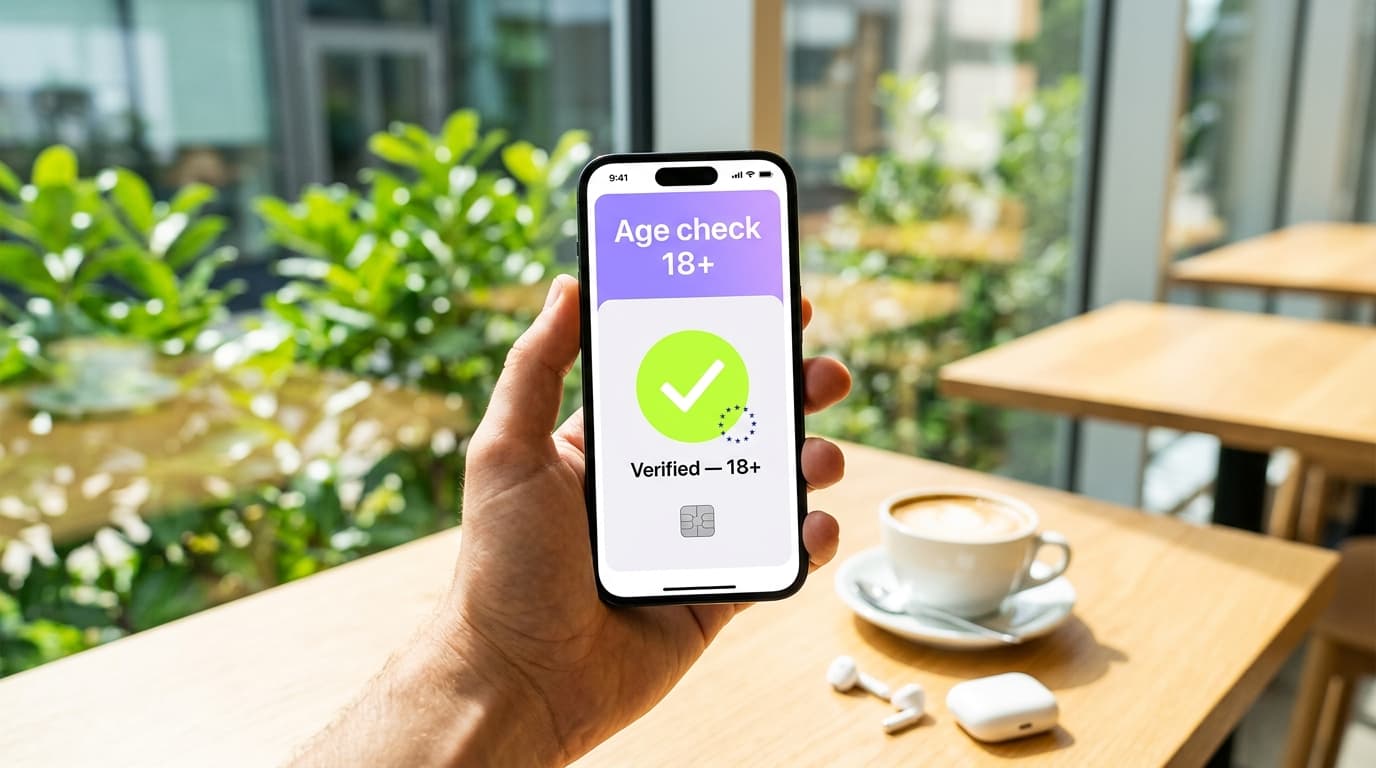
The EU Commission has set June 2026 as the deadline for member states to launch interoperable age verification apps built on the European Digital Identity (EUDI) Wallet. For creators monetising content — from exclusive memberships to age-restricted products — this fundamentally changes how you can and must organise access to your content. Below you'll find the technical details, the timeline, and a 5-step checklist to prepare.
⚡ EU age checks go mobile and privacy-first. Jump to the 5-step checklist, or try LinkDash free.
Key concepts: EUDI Wallet, DSA, and age verification
- EUDI Wallet (European Digital Identity Wallet)
- In one sentence: An EU-standardised mobile app that allows citizens to prove their identity, age, and other attributes without sharing unnecessary personal data.
- DSA (Digital Services Act)
- In one sentence: EU regulation requiring online platforms to provide transparency, content moderation, and protection of minors — including "reasonable age assurance" for harmful content.
- Age Assurance vs. Age Verification
- In one sentence: Age assurance is the umbrella term for all methods (estimation, verification, self-declaration); age verification requires hard evidence such as ID or wallet attestation.
- Zero-knowledge proof
- In one sentence: A cryptographic technique that lets you prove you're 18+ without revealing your date of birth or other identifying information.
- Interoperability
- In one sentence: The requirement that age verification systems from different member states communicate seamlessly — a German app must work on a Dutch platform, and vice versa.
What exactly is the EU Commission saying about age verification?
Short answer: The Commission has explicitly chosen a mobile-app route via the EUDI Wallet, with June 2026 as the deadline for member states to present working systems.
The February 2024 recommendation, tightened in subsequent guidance, sets out a concrete roadmap:
- 30 June 2026: Member states are "encouraged" (read: pressured) to have interoperable age verification apps working with the EUDI Wallet infrastructure.
- End of 2026: Full rollout expected, with cross-border interoperability as the minimum requirement.
- Privacy-by-design: Systems must support zero-knowledge attestations — platforms may only know "18+ yes/no", not your date of birth or name.
According to the Future of Privacy Forum, the Commission deliberately chose this mobile app route over alternatives like AI-based age estimation or credit card verification. The reasoning: wallet-based attestations are more privacy-friendly and harder to circumvent than a simple date-of-birth dropdown. This mirrors concerns raised by the UK's Information Commissioner's Office, which has flagged similar privacy issues with invasive verification methods.
Why is the EU choosing mobile apps instead of platform-side verification?
Short answer: Control stays with the user, data minimisation is enforced, and it avoids a fragmented landscape where every platform deploys its own (often invasive) verification method.
The current situation is a patchwork. Some platforms ask for ID uploads (privacy nightmare), others use AI facial estimation (inaccurate and bias-prone), still others do nothing at all. The mobile wallet approach centralises verification with the citizen themselves:
| Verification method | Privacy impact | Accuracy | Cross-platform | EU compliance 2026 |
|---|---|---|---|---|
| EUDI Wallet attestation | Minimal (zero-knowledge) | 100% (ID-based) | Yes | Full |
| ID document upload | High (full data) | 99%+ | No | Uncertain |
| AI facial estimation | Medium (biometric) | 70-85% | No | Probably not |
| Credit card verification | Medium (financial data) | ~95% | Partial | Uncertain |
| Phone number verification | Low-medium | ~80% | No | No |
| Self-declaration (checkbox) | None | 0% | N/A | No |
The Commission has also explicitly criticised national social media bans (like those in some US states, including Utah and Arkansas) as disproportionate. The EU route is: no platform bans, but robust age verification for specific content and services.
What does this mean for different types of creator?
Adult content creators (OnlyFans, Fansly, own sites)
For you, this is the most significant change. The DSA already requires "reasonable age assurance" for content that may be harmful to minors. With the EUDI Wallet route, you'll soon have a standardised way to do this without having to process ID documents yourself. Platforms like OnlyFans will likely integrate wallet verification; if you run your own site, you'll need to integrate a wallet-compatible verification provider yourself.
Membership creators (Patreon, Ko-fi, own communities)
If you have tiers with age-restricted content — think alcohol-related content, explicit art, or discussions on adult themes — you'll need to determine per tier whether age verification is required. The wallet route makes this technically simpler: one attestation request instead of managing ID uploads.
E-commerce creators (own merch, dropshipping)
Selling products with age restrictions (alcohol, vapes, certain supplements)? The EUDI Wallet will likely become the standard checkout verification. Integrate early to avoid playing catch-up.
Mainstream content creators (YouTube, TikTok, Instagram)
For most content, little changes directly. The major platforms will build their own wallet integrations. However: if your bio-link points to age-restricted content or products, that landing page may soon need to support verification.
Education and coaching creators
Offering courses or coaching on potentially age-sensitive topics (financial advice, relationships, health)? The rules are still unclear, but "reasonable age assurance" may apply here too. Keep track of developments.
5-step checklist: preparing for EU age verification
- Audit your content and products: Make a list of everything you offer that might fall under age restrictions. Think broader than just "adult content" — also alcohol, gambling, certain health products.
- Check your current platforms: Ask Patreon, OnlyFans, or your e-commerce platform about their EUDI Wallet roadmap. No answer? That's a red flag.
- Evaluate your own sites: If you have your own website or landing page for age-restricted content, research wallet-compatible verification providers. Yoti, IDnow, and others are already building integrations.
- Update your privacy policy: Even if you haven't implemented verification yet, your privacy policy should mention how you handle (or will handle) age data.
- Follow national implementation: The EU provides the framework, but member states implement. Track developments in your country — the UK (post-Brexit, but watching closely), Ireland, Germany, and France may have different timelines.
⚡ Want to future-proof your bio-link?
LinkDash is built with privacy-first principles and is preparing integrations with EU-compliant verification providers. One dashboard for all your links, analytics, and soon: compliant age verification.
Try LinkDash free → no credit card · 5-minute setup
Edge cases and grey areas
"My content is borderline — not explicit, but not for children either"
The DSA speaks of content that "may be harmful to minors". This is deliberately vague. Horror content, violent gaming streams, discussions about drug use — it depends on context and platform. Rule of thumb: if you're in doubt, prepare verification options.
"I only sell to adults but the product itself isn't restricted"
If your product is legal for all ages but your target audience is adults (for example, luxury items), you probably don't have a verification obligation. But: check your terms of service and be explicit about your target demographic.
"My audience is international, not just EU"
The EUDI Wallet is EU-specific, but the DSA applies to platforms serving EU citizens. You'll likely need a phased approach: wallet verification for EU visitors, alternative methods for others. US-based creators with significant European audiences should pay particular attention here.
"I only use major platforms, no own site"
Then the technical implementation sits with the platform, not with you. But: you remain responsible for the content you post. If a platform has inadequate verification and your content reaches minors, that can come back to you.
"The deadline is June 2026 — don't I still have time?"
Technically yes, practically no. The EUDI Wallet infrastructure is being built now. Early adopters get better integrations, lower costs, and less rush. Wait until it's mandatory, and you'll pay premium prices for rush implementations.
Note: this article provides general information about EU regulation in development. Exact implementation differs per member state and may change. Consult a legal adviser for specific advice on your situation.
Sources and further reading
- Future of Privacy Forum: The EU Commission's Approach to Age Verification
- Inside Privacy: EU Sets the Clock on Age Verification Rollout
- EU Digital Strategy: EUDI Wallet Implementation
- EUR-Lex: Digital Services Act (full text)
- UK ICO: Age Appropriate Design Code
Frequently asked questions
What is the EUDI Wallet?
The EUDI Wallet (European Digital Identity Wallet) is an EU-standardised mobile app that allows citizens to prove their identity, age, and other attributes without sharing unnecessary personal data. It will become the backbone of age verification in the EU.
What is the difference between age assurance and age verification?
Age assurance is the umbrella term for all methods of determining age, including estimation and self-declaration. Age verification requires hard evidence such as ID documents or wallet attestations. The EU recommendation focuses on actual verification.
What is a zero-knowledge proof?
A zero-knowledge proof is a cryptographic technique that lets you prove you're 18+ without revealing your date of birth or other identifying information. The EUDI Wallet will use this technique for privacy-friendly age verification.
What does interoperability mean for age verification?
Interoperability means that age verification systems from different EU member states communicate seamlessly. A German wallet app must work on a Dutch platform, and vice versa.
When must age verification via the EUDI Wallet be operational?
The EU Commission has set 30 June 2026 as the deadline for member states to present interoperable age verification apps. Full rollout is expected by the end of 2026.
What content falls under age verification requirements?
The DSA speaks of content that "may be harmful to minors". This includes explicit adult content, but also potentially violent content, gambling-related content, and products with age restrictions such as alcohol.
Do I as a creator need to implement age verification myself?
That depends on your setup. If you use major platforms like OnlyFans or Patreon, they implement the technical side. If you have your own websites or landing pages with age-restricted content, you'll need to integrate a wallet-compatible verification provider yourself.
What if my audience is mainly outside the EU?
The EUDI Wallet is EU-specific, but the DSA applies to platforms serving EU citizens. You'll likely need a phased approach: wallet verification for EU visitors, alternative methods for visitors from outside the EU.
Will credit card verification still be allowed after 2026?
Probably as a supplementary method, but not as the primary EU-compliant verification. The EU recommendation explicitly prefers wallet-based attestations due to better privacy properties.
What will age verification via the EUDI Wallet cost creators?
The pricing structure is not yet finalised. Verification providers are expected to offer per-verification or subscription models. Early integration will likely secure better rates than waiting until it's mandatory.
Can I start EUDI Wallet integration now?
The infrastructure is still in development, but providers like Yoti and IDnow are already building pilot integrations. You can contact them now to get on their early-adopter list and follow developments.
What happens if I miss the deadline?
The DSA has enforcement mechanisms including fines. For individual creators, the risk depends on your platform and content type. Platforms will likely implement stricter content policies to ensure their own compliance — which indirectly affects you too.
Want to learn more about keeping your online presence compliant and future-proof? Also read our articles on DSA compliance for creators and privacy-first bio-links.