
Mandatory EU AI sandboxes from August 2026 — practical access guide for creators
Every EU member state must have an operational AI regulatory sandbox by 2 August 2026. What does this mean for creators building or using AI tools? A practical guide covering access requirements, timelines, and scenarios by creator type.
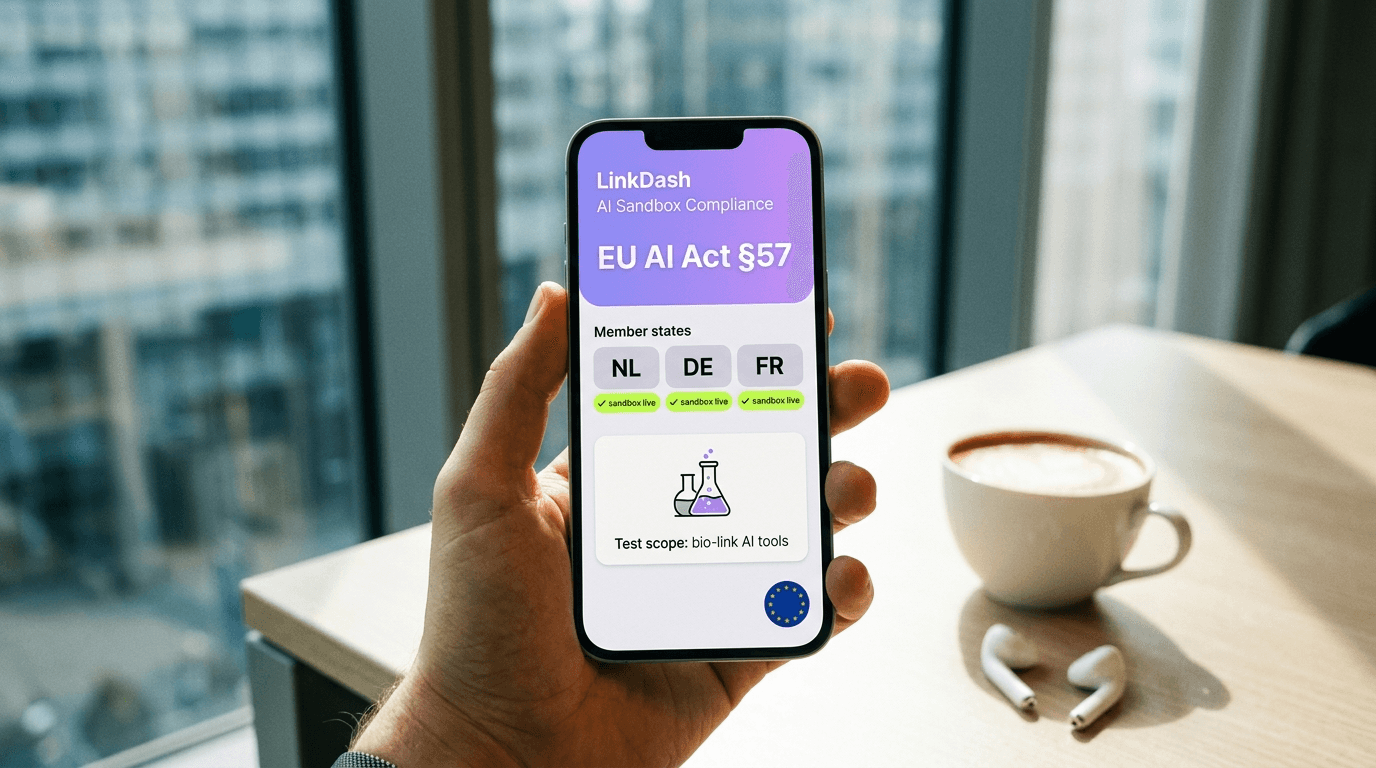
From 2 August 2026, every EU member state must have at least one operational AI regulatory sandbox — a controlled testing environment where you can develop and test AI systems under supervision of the national authority, without immediately having to meet all AI Act compliance requirements. For creators building, training, or commercially deploying AI tools, this opens a legal experimentation space that previously didn't exist. Jump to the 5-step checklist for immediate action.
⚡ Test your AI tool legally before full compliance. Jump to the 5-step checklist, or try LinkDash free.
Definitions — AI Act terminology for creators
- AI regulatory sandbox
- In one sentence: A government-managed testing environment where you can develop, train, and validate AI systems under supervision, with temporary exemptions from certain AI Act obligations.
- AI Act (Regulation (EU) 2024/1689)
- In one sentence: The European law that classifies AI systems by risk and imposes obligations on providers and deployers, ranging from minimal (spam filters) to prohibited (social scoring).
- High-risk AI system
- In one sentence: AI applications in sectors such as employment, education, creditworthiness, or biometrics that must meet strict requirements before market introduction.
- Provider
- In one sentence: The party that develops or commissions an AI system and places it on the market under their own name — if you're a creator selling an AI tool, you're a provider.
- Deployer
- In one sentence: The party that uses an AI system in a professional context, other than for purely personal use — if you're a creator using AI tools for your business, you're a deployer.
- Transparency obligations (Article 50)
- In one sentence: Rules requiring you to inform the public when content is AI-generated, or when they're interacting with an AI system.
What exactly is an AI regulatory sandbox?
Short answer: A sandbox is a legally defined testing environment where you can develop AI innovations under guidance from the national regulator, with temporary exemptions from full compliance requirements.
The AI Act requires every member state to have at least one operational sandbox by 2 August 2026. This isn't a voluntary recommendation — it's explicitly stated in the regulation as a deadline for national implementation. The sandbox must be accessible to both large companies and small providers and startups, with priority given to SMEs.
Within the sandbox, you can:
- Develop and test AI systems in a controlled environment
- Get feedback from regulators before going to market
- Have compliance questions answered specific to your use case
- Involve real users in testing on a limited basis (under conditions)
What you cannot do: use the sandbox as a permanent excuse to operate outside the law. There are time limits, reporting obligations, and exit criteria.
Why is this relevant for creators?
Short answer: As soon as you build, train, or commercially offer AI tools to your audience, you fall under the AI Act as a provider or deployer — the sandbox gives you a safe route to test compliance.
The creator economy is increasingly intertwined with AI. Consider:
- Custom GPTs or chatbots you sell via your link-in-bio
- AI-generated content you monetise
- Recommendation algorithms in your own apps or platforms
- AI-driven personalisation for your products or services
Article 50 of the AI Act imposes explicit transparency obligations. If you offer an AI system that generates synthetic audio, images, video, or text, you must ensure the output is machine-readably marked as AI-generated. As a deployer, you must inform users when they're interacting with an AI system.
The sandbox gives you the opportunity to figure out how to implement this before you're liable for non-compliance.
Timeline and deadlines — what happens when?
Short answer: The AI Act takes effect in phases; sandboxes must be operational by 2 August 2026, but many obligations apply earlier.
| Date | What happens | Impact on creators |
|---|---|---|
| 1 August 2024 | AI Act entered into force | Law adopted, implementation begins |
| 2 February 2025 | Prohibited AI practices in force | Social scoring, manipulative AI banned |
| 2 August 2025 | Governance structures operational | National authorities designated |
| 2 August 2026 | Sandboxes mandatory operational | Access to testing environment possible |
| 2 August 2026 | High-risk AI obligations fully apply | Annex I and III systems must be compliant |
| 2 August 2027 | All AI Act provisions fully apply | Full enforcement possible |
Access requirements — who qualifies?
Short answer: Any provider or prospective provider of AI systems can apply for access, with priority given to SMEs and startups.
The AI Act specifies that sandboxes must offer "preferential terms" to small providers and startups. This doesn't mean automatic access, but it does mean:
- Lower or no access fees
- Simplified application procedures
- Guidance on compliance questions
- Access to the same facilities as large companies
What you need to demonstrate in an application (expected, details vary by member state):
- Description of the AI system you want to develop or test
- Intended purpose and use cases
- Identification of potential risks
- Plan for testing and validation
- Exit strategy: how you'll achieve full compliance after the sandbox
Scenarios by creator type
Content creator with AI-generated media
You create AI-generated images, videos, or audio that you sell or monetise. Under Article 50, your output must be marked as AI-generated. The sandbox can help you determine which watermarking method is compliant, how to implement metadata, and whether your current workflow meets requirements.
Sandbox action: Test your content pipeline for Article 50 compliance before August 2027.
Creator-entrepreneur with custom AI tools
You build and sell custom GPTs, chatbots, or AI assistants via your link-in-bio. You're a provider under the AI Act. The sandbox gives you access to regulators who can assess whether your tool falls under high-risk, what documentation you need, and how to implement transparency requirements.
Sandbox action: Have your tool classified and get feedback on your compliance roadmap.
Educator or coach with AI personalisation
You offer courses or coaching with AI-driven personalisation or assessment. AI in education can fall under high-risk (Annex III). The sandbox is crucial for determining whether your specific application qualifies and what that means for your obligations.
Sandbox action: Get clarity on classification before you scale.
Influencer with AI-driven recommendations
Your platform or app uses AI to recommend content or products to your audience. Recommendation systems have transparency obligations. The sandbox can help you understand what information you need to share about how your algorithm works.
Sandbox action: Test your disclosure texts and technical implementation.
Developer-creator with AI SaaS
You build AI tooling as a service for other creators. You're a provider, and potentially responsible for downstream compliance as well. The sandbox gives you the opportunity to validate your complete compliance architecture before going to market.
Sandbox action: Validate your technical and legal architecture end-to-end.
5-step checklist for sandbox access
- Identify your role: Are you a provider (you build/sell AI) or deployer (you use AI professionally)? This determines your obligations.
- Classify your AI system: Does it fall under prohibited practices, high-risk, limited risk (transparency), or minimal risk? Use the AI Act text or the decision tool at artificialintelligenceact.eu.
- Find your national authority: Each member state designates a competent authority. For the UK, post-Brexit arrangements mean you'll need to check both UK-specific AI guidance and EU requirements if you serve EU customers. For Ireland, this will likely be coordinated through existing data protection structures. Check digital-strategy.ec.europa.eu for updates.
- Prepare your application: Document your AI system, intended use, risk analysis, and test plan. The more concrete, the faster the assessment.
- Submit in good time: Sandboxes open August 2026, but don't wait until the last moment. Early applicants will likely receive more guidance.
⚡ Want to present your AI tools professionally while you work out compliance?
LinkDash gives you a clean, fast link-in-bio without tracking bloat — ideal for creators who take transparency seriously.
Try LinkDash free → no credit card · 5 minute setup
Edge cases and grey areas
I only use existing AI tools (ChatGPT, Midjourney) — do I need the sandbox?
Probably not. If you're purely an end user of tools that others provide, you're not a provider. But if you deploy these tools in a professional context (coaching, consulting, content production for clients), you may be a deployer with transparency obligations. The sandbox isn't necessary then, but can still help with compliance questions.
My AI tool is free — do I still fall under the AI Act?
Yes. The AI Act makes no distinction between paid and free systems for the definition of provider. If you place an AI system on the market under your own name, you're a provider — regardless of pricing model.
I'm outside the EU but have EU customers — should I be concerned?
Yes. The AI Act has extraterritorial reach. If you offer AI systems to users in the EU, or if the output of your system is used in the EU, you fall under the regulation. The sandbox may also be accessible to non-EU providers, depending on national implementation. This is particularly relevant for UK-based creators post-Brexit who serve audiences across the Channel.
My AI tool already exists and is running — can I still enter the sandbox?
The sandbox is primarily intended for development and testing before market introduction, but the AI Act doesn't explicitly exclude existing systems. You can likely use the sandbox to validate and adapt an existing system for compliance. Check the specific conditions of your national sandbox.
What if my AI system is rejected for the sandbox?
Rejection doesn't mean your system is illegal — it means you don't qualify for the temporary exemptions and guidance of the sandbox. You can still go to market, but must then immediately meet all applicable requirements. Consider legal advice if you're unsure about your classification.
Disclaimer: This information is based on the published AI Act text and official EU sources. National implementation may vary. For legally binding advice on your specific situation, consult a specialist in EU AI regulation.
Sources
- The EU Artificial Intelligence Act — artificialintelligenceact.eu
- AI Act — European Commission Digital Strategy
- Article 50: Transparency Obligations for Providers and Deployers of Certain AI Systems
- Regulation (EU) 2024/1689 — EUR-Lex official publication
- AI Office — European Commission
Frequently asked questions
What is an AI regulatory sandbox?
An AI regulatory sandbox is a government-managed testing environment where you can develop, train, and validate AI systems under supervision, with temporary exemptions from certain AI Act obligations.
What is the AI Act?
The AI Act (Regulation (EU) 2024/1689) is the European law that classifies AI systems by risk and imposes obligations on providers and deployers, ranging from minimal (spam filters) to prohibited (social scoring).
What is a high-risk AI system?
High-risk AI systems are AI applications in sectors such as employment, education, creditworthiness, or biometrics that must meet strict requirements before market introduction.
What are the transparency obligations under Article 50?
Article 50 of the AI Act imposes rules requiring you to inform the public when content is AI-generated, or when they're interacting with an AI system. If you offer an AI system that generates synthetic audio, images, video, or text, you must ensure the output is machine-readably marked as AI-generated.
When must AI sandboxes be operational?
Every EU member state must have at least one AI regulatory sandbox operational by 2 August 2026. This is a mandatory deadline from the AI Act.
Am I a provider or deployer under the AI Act?
You're a provider if you develop or commission an AI system and place it on the market under your own name. You're a deployer if you use an AI system in a professional context, other than for purely personal use. As a creator selling AI tools, you're a provider; as a creator using AI tools for your business, you're a deployer.
Who qualifies for the AI sandbox?
Any provider or prospective provider of AI systems can apply for access, with priority given to SMEs and startups. The AI Act specifies that sandboxes must offer preferential terms to small providers.
What does access to the AI sandbox cost?
The exact costs vary by member state, but the AI Act requires sandboxes to offer preferential terms to SMEs and startups, which may mean lower or no access fees for smaller providers.
Do I fall under the AI Act if my AI tool is free?
Yes. The AI Act makes no distinction between paid and free systems for the definition of provider. If you place an AI system on the market under your own name, you're a provider — regardless of pricing model.
Does the AI Act apply outside the EU?
Yes. The AI Act has extraterritorial reach. If you offer AI systems to users in the EU, or if the output of your system is used in the EU, you fall under the regulation.
Can I use the sandbox for an existing AI system?
The sandbox is primarily intended for development and testing before market introduction, but the AI Act doesn't explicitly exclude existing systems. You can likely use the sandbox to validate and adapt an existing system for compliance.
Where can I find the national AI authority for my country?
Each member state designates a competent authority by August 2025. Check digital-strategy.ec.europa.eu for updates by member state.
The AI sandbox requirement is a concrete example of how the EU wants to facilitate innovation within a regulated framework. For creators seriously working with AI tools, now is the time to prepare — not to wait until enforcement begins.
Next step: Read our guide on Article 50 transparency obligations for specific implementation requirements, or check out the creator compliance roadmap for 2026.
Max
Content Specialist at LinkDash
Max is Content Specialist at LinkDash with a focus on the German-speaking market. He writes about GDPR-compliant link-in-bio strategies, content marketing and how European creators reach their audience without sacrificing privacy.
Ready to get started?
Create your own link-in-bio page for free with iDEAL, Wero and 100+ templates.
Start free