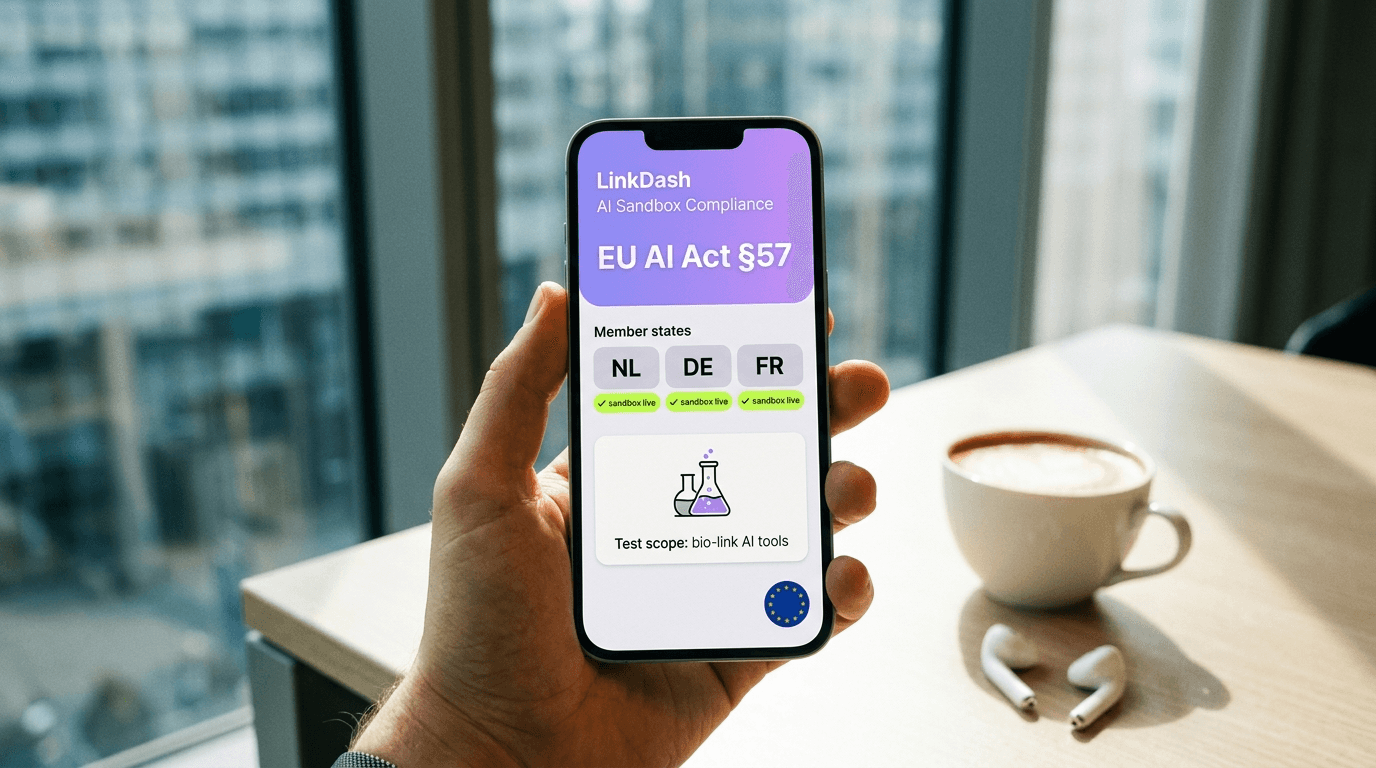
Every EU member state must have at least one 'regulatory sandbox' for artificial intelligence operational by 2 August 2026 — a controlled testing environment where AI systems can be developed and tested under the supervision of national authorities. For creators who use AI tools for content, automation, or monetisation, this means both new compliance obligations and access to safe experimentation space. Scroll to the 5-step checklist for concrete action points.
⚡ The AI sandbox deadline approaches fast. Jump to the 5-step checklist, or try LinkDash free.
Core Concepts: AI Act, Sandbox, and Transparency Obligations
- EU AI Act
- In one sentence: The world's first comprehensive AI legislation, which classifies AI systems by risk and imposes obligations per category on both developers and users.
- Regulatory sandbox
- In one sentence: A government-controlled testing environment where companies and developers can trial new AI applications under temporarily relaxed rules, with direct supervision from the competent authority.
- Transparency obligations (Article 50)
- In one sentence: Legal requirements that users must be informed when they interact with AI systems, particularly with chatbots, deepfakes, and synthetic content.
- High-risk AI system
- In one sentence: AI applications that can have significant impact on health, safety, or fundamental rights — think credit scoring, recruitment, or biometric identification.
- General-purpose AI (GPAI)
- In one sentence: AI models that can be deployed for various tasks without specific adaptation, such as large language models (LLMs) that generate text, images, or code.
What exactly does the sandbox requirement entail?
Short answer: Article 57 of the EU AI Act requires every member state to have at least one national AI sandbox operational by 2 August 2026, accessible to both large tech companies and small developers and startups.
The sandbox requirement is not a voluntary recommendation. It's a hard deadline stemming from the phased implementation of the AI Act. Following publication in the EU Official Journal on 12 July 2024, the following timeline applies:
- 2 February 2025: Prohibited AI practices come into force
- 2 August 2025: Obligations for GPAI models
- 2 August 2026: Sandbox requirement + full application of AI Act
The sandbox must provide 'fair access' according to the legislation, with priority for small and medium-sized enterprises (SMEs) and startups. This is relevant for creators: solo entrepreneurs and small creator businesses fall under the SME definition and can therefore claim access to these testing environments.
The UK's Information Commissioner's Office has run its own regulatory sandbox since 2019, and early participants reported significant value in pre-launch compliance validation. The EU's mandatory framework aims to replicate this across all 27 member states — a far more ambitious undertaking that will create a patchwork of national approaches unified by common principles.
Why is this relevant for creators?
Short answer: Creators who use AI tools for content generation, automation, or audience interaction fall under Article 50's transparency obligations — and can use sandboxes to have their tools tested before going live.
The creator economy in Europe is projected to grow to more than €20 billion by 2027. A substantial portion of that growth is driven by AI tooling: from automatic video editing and thumbnail generation to AI chatbots for community management and personalised content recommendations.
Article 50 of the AI Act imposes specific transparency obligations:
- AI-generated content must be labelled as such when it contains synthetic audio, video, or text that is indistinguishable from real
- Chatbots must inform users that they are interacting with an AI system
- Deepfakes and synthetic media must be marked in a machine-readable manner
For creators, this means the tools you use — or build yourself — must comply with these requirements. The sandbox offers a safe space to test whether your implementation is compliant, without immediate enforcement risks.
Overview: Sandbox Status by Major EU Member State
| Member State | Sandbox Operational? | Responsible Authority | SME/Creator Access | Expected Launch | Focus Sectors |
|---|---|---|---|---|---|
| Netherlands | In preparation | Dutch Data Protection Authority + RDI | Yes, SME priority | Q1 2026 | Financial services, media |
| Germany | Pilot active | BNetzA + state authorities | Yes | Operational 2025 | Industry 4.0, mobility |
| France | In preparation | CNIL + Inria | Yes, startup focus | H1 2026 | Creative industries, healthcare |
| Spain | Operational | AESIA | Yes | Since 2022 (pilot) | Broad, incl. content platforms |
| Belgium | In preparation | Data Protection Authority | Unknown | 2026 | Not yet specified |
| Italy | In preparation | AgID + Garante | Yes | 2026 | Public sector, media |
| Poland | Early stage | Still to be designated | Unknown | 2026 | Not yet specified |
| Sweden | In preparation | IMY + AI Sweden | Yes | 2025-2026 | Fintech, e-commerce |
Note: This table is based on publicly available information as of June 2025. Exact implementation may vary by member state.
What does this mean for your type of creator business?
Solo creator with AI editing tools
Do you use tools like Runway, Descript, or CapCut with AI features? Then you fall under Article 50 as a 'deployer' once you publish synthetic content that isn't clearly recognisable as AI-generated. The sandbox is less relevant for pure usage, but highly relevant if you build or sell your own AI workflows.
Creator with your own AI chatbot or community tool
Are you building an AI chatbot for your Discord, Telegram, or website? Then you're a 'provider' of an AI system and must inform users that they're talking to AI. The sandbox is ideal for having your implementation tested before rolling out to your full community.
Creator agency or SaaS for creators
Do you offer AI services to other creators? Then you almost certainly fall under the stricter provider obligations. The sandbox gives you a controlled environment to validate compliance and potentially obtain a CE-marking equivalent for AI.
Creator selling AI-generated products
Do you sell AI art, music, or text? Article 50 requires that buyers know it's AI-generated content. The sandbox can help test whether your labelling and disclosure meet the technical standards the European Commission has yet to publish.
Influencer with sponsored AI tool partnerships
Do you promote third-party AI tools? Your own compliance risk is limited, but your reputation is tied to your partners' compliance. Ask whether their tools have been sandbox-tested — this is becoming a quality mark.
5-Step Checklist: Prepare for August 2026
- Inventory your AI usage: Make a list of all AI tools you use or offer. Categorise them as 'deployer' (user) or 'provider' (supplier).
- Check transparency requirements: For each tool: do you need to inform users/audiences about AI interaction? If so, implement clear labelling.
- Monitor your national sandbox: Follow announcements from your national supervisory authority. In the UK, the ICO maintains guidance on AI; US-based creators targeting EU audiences should monitor the European Commission's updates.
- Consider sandbox registration: If you build your own AI tools or offer AI services, register as soon as the sandbox opens. This gives you a compliance head start.
- Document your AI processes: The AI Act requires traceability. Track which AI models you use, which versions, and how you label output.
⚡ How many platforms do you need to stay compliant?
LinkDash centralises your creator links on one page you fully control. No vendor lock-in, transparent pricing, and built with European privacy standards.
Try LinkDash free → no credit card · 5 minutes setup
Edge Cases and Grey Areas
I only use ChatGPT for brainstorming — do I fall under the AI Act?
Purely internal use for idea generation falls outside transparency obligations. Once you publish the output as content that is 'manifestly generated by an AI system', you must label it. The boundary isn't sharply defined; technical standards will follow in 2025-2026.
My AI tool is made by an American company — does the EU AI Act apply?
Yes. The AI Act has extraterritorial effect: if you publish AI output in the EU or reach EU citizens, the obligations apply. The provider (the American company) must also be compliant if they operate in the EU.
I already label my AI content with 'made with AI' — is that enough?
Probably not fully. Article 50 also requires machine-readable marking (metadata/watermarking) for synthetic content. The technical specifications are still being developed by CEN/CENELEC.
What if my member state doesn't have a sandbox by the deadline?
The European Commission can initiate infringement proceedings against member states that miss the deadline. For you as a creator, little changes — you'll fall under the general AI Act rules without a sandbox option.
Are sandboxes free to access?
The AI Act prescribes that sandboxes must provide 'fair access' with priority for SMEs. Most pilots to date have been cost-free, but member states may charge administrative fees. Details will follow per national implementation.
Disclaimer: This article is informational and not legal advice. AI Act implementation is still developing; consult a specialist for specific compliance questions.
Sources and Further Reading
- The EU Artificial Intelligence Act — Official consolidation and explanation
- Article 50: Transparency obligations for providers and deployers of certain AI systems
- FiscalNote: Fair and Future-Proof — Europe's Creator Economy in Focus
- European Commission: Regulatory framework on AI
- EUR-Lex: Regulation (EU) 2024/1689 — AI Act full text
Frequently Asked Questions
What is the EU AI Act?
The EU AI Act is the world's first comprehensive AI legislation, which classifies AI systems by risk and imposes obligations per category on both developers and users.
What is a regulatory sandbox?
A regulatory sandbox is a government-controlled testing environment where companies and developers can trial new AI applications under temporarily relaxed rules, with direct supervision from the competent authority.
What are transparency obligations under Article 50?
Transparency obligations under Article 50 are legal requirements that users must be informed when they interact with AI systems, particularly with chatbots, deepfakes, and synthetic content.
What is a high-risk AI system?
A high-risk AI system is an AI application that can have significant impact on health, safety, or fundamental rights — think credit scoring, recruitment, or biometric identification.
What is general-purpose AI (GPAI)?
General-purpose AI are AI models that can be deployed for various tasks without specific adaptation, such as large language models (LLMs) that generate text, images, or code.
When must all EU member states have an AI sandbox?
All EU member states must have at least one national AI sandbox operational by 2 August 2026, in accordance with Article 57 of the AI Act.
Do I need to label my AI content as a creator?
Yes, if you publish synthetic content that is not clearly recognisable as AI-generated. Article 50 requires that AI-generated content be labelled as such, including machine-readable marking.
Does the AI Act apply to American AI tools I use?
Yes. The AI Act has extraterritorial effect: if you publish AI output in the EU or reach EU citizens, the obligations apply.
Can I access a regulatory sandbox as a solo creator?
Yes, the AI Act prescribes that sandboxes must provide 'fair access' with priority for small and medium-sized enterprises (SMEs) and startups. Solo entrepreneurs fall under the SME definition.
What happens if my member state misses the sandbox deadline?
The European Commission can initiate infringement proceedings against member states that miss the deadline. For you as a creator, little changes — you'll fall under the general AI Act rules without a sandbox option.
Is the label 'made with AI' sufficient for compliance?
Probably not fully. Article 50 also requires machine-readable marking (metadata/watermarking) for synthetic content. The technical specifications are still being developed by CEN/CENELEC.
Where can I find the full text of the EU AI Act?
The full text is available on EUR-Lex as Regulation (EU) 2024/1689, and in accessible form on artificialintelligenceact.eu.
Conclusion and Next Steps
The EU AI Act's sandbox requirement isn't an abstract policy document — it directly affects how creators can deploy, test, and account for AI tools. With just over a year until the 2 August 2026 deadline, now is the time to inventory your AI usage and monitor your national sandbox.
Want to centralise your creator links and tools on a platform that takes European privacy standards seriously? Try LinkDash free — no credit card, set up in five minutes.
Also read: DORA regulation for creators and Transparency obligation for AI content in Europe.