
Germany's Kleinunternehmer rule 2026: the new €25,000 threshold explained for creators
Germany raised the Kleinunternehmer (small-business) VAT threshold to €25,000 in 2025. Here's what that means for UK and international creators earning income in Germany — complete guide with checklist.
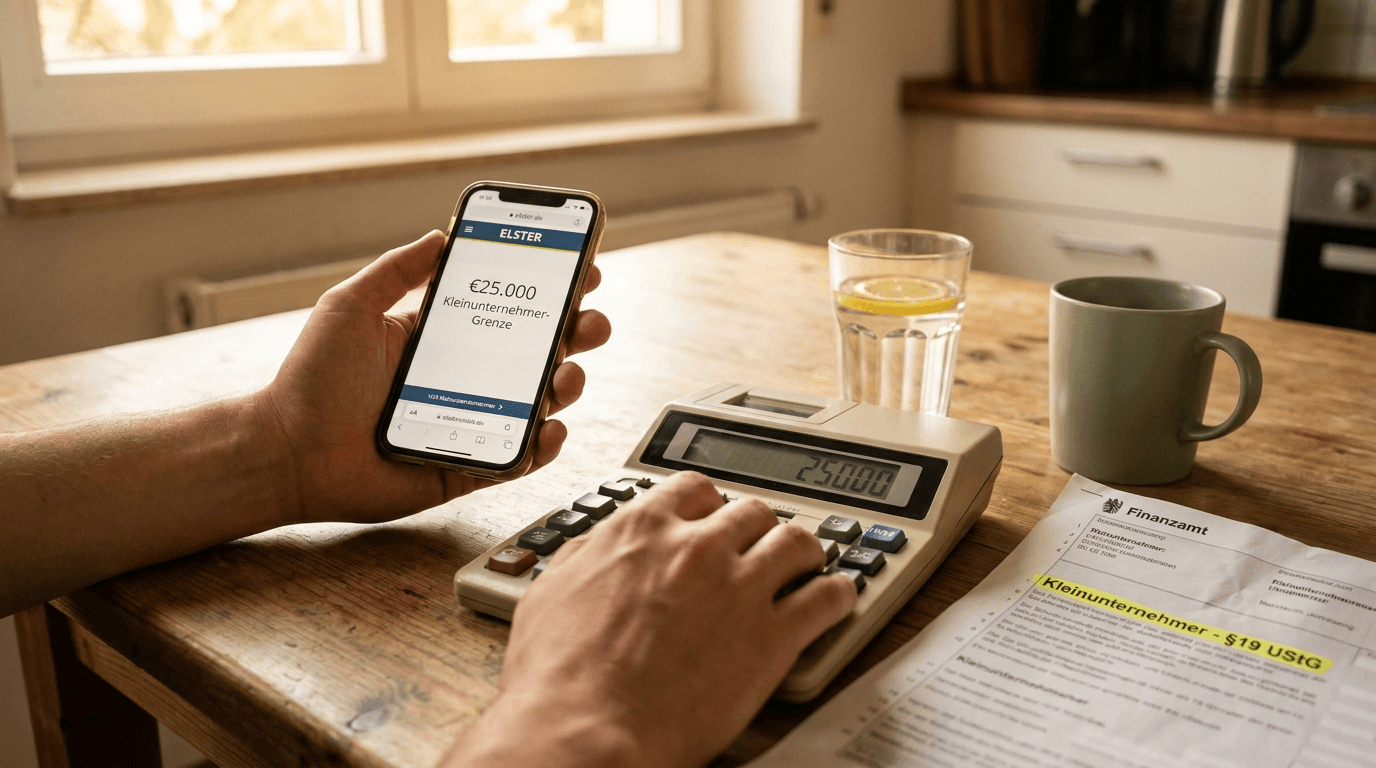
From 1 January 2025, the Kleinunternehmer threshold in Germany has been raised to €25,000 turnover per year. This means small business owners and creators who stay below this threshold don't need to charge or pay VAT (Umsatzsteuer). Scroll to the 5-step checklist to see if this scheme works for you.
⚡ Save admin time as a Germany-based creator. Jump to the 5-step checklist, or try LinkDash free.
Definitions: Kleinunternehmer Terms Explained
- Kleinunternehmer
- In one sentence: A small business owner in Germany who, due to low turnover, doesn't need to charge VAT to customers.
- Kleinunternehmerregelung
- In one sentence: The German tax regulation that exempts small business owners from VAT obligations when they remain below the turnover threshold.
- Umsatzsteuer
- In one sentence: The German term for sales tax or VAT, standard rate 19% in Germany.
- Finanzamt
- In one sentence: The local tax office in Germany that processes your business registration and tax returns.
- Steuernummer
- In one sentence: Your German tax number that you need for invoices and tax returns.
- Umsatz
- In one sentence: Turnover or revenue — the total amount you invoice, excluding VAT.
What exactly is the Kleinunternehmerregelung?
Short answer: The Kleinunternehmerregelung is a German tax exemption that allows small business owners not to charge or pay VAT. In return, you also cannot reclaim VAT on business purchases.
The scheme has existed for years, but the thresholds were significantly raised from 2025. According to All About Berlin, the current rule is: if your turnover in the previous year was below €25,000, and your expected turnover in the current year stays below €100,000, you qualify.
For creators, this means concretely: no 19% VAT on your invoices, which makes your services cheaper for end customers. You also don't need to file monthly or quarterly VAT returns. The downside: you cannot reclaim VAT on your business expenses (laptop, camera, software).
For UK creators who've relocated to Germany — perhaps drawn by Berlin's thriving creative scene or Munich's tech ecosystem — this threshold offers significant breathing room during your first years of building an audience. It's worth noting that since Brexit, UK nationals working in Germany face the same registration requirements as any non-EU citizen, making the simplified Kleinunternehmer route particularly appealing.
What are the new turnover thresholds from 2025?
Short answer: The threshold for the previous year is €25,000 (was €22,000), and the threshold for the current year is €100,000 (was €50,000).
| Aspect | Until 2024 | From 2025 |
|---|---|---|
| Previous year turnover limit | €22,000 | €25,000 |
| Expected current year turnover | €50,000 | €100,000 |
| VAT on invoices | Not required | Not required |
| VAT deduction on purchases | Not possible | Not possible |
| Umsatzsteuervoranmeldung required | No | No |
| Income tax required | Yes | Yes |
| Gewerbesteuer possible | Above €24,500 profit | Above €24,500 profit |
| Valid EU-wide | No | Yes (since 2025) |
Important: according to Norman Finance, as a Kleinunternehmer you still pay income tax (Einkommensteuer) on your profit. The exemption only applies to sales tax.
Which taxes does a Kleinunternehmer still need to pay?
Short answer: Income tax always, and Gewerbesteuer if your profit exceeds €24,500.
The Kleinunternehmerregelung is not a total tax exemption. You're only exempt from VAT obligations. What you still need to pay:
- Einkommensteuer — income tax on your net profit, progressive rate up to 45%
- Gewerbesteuer — municipal trade tax, only if your profit exceeds €24,500
- Solidaritätszuschlag — solidarity surcharge of 5.5% on top of your income tax (for higher earners)
For most creators with modest incomes, Einkommensteuer is the only relevant tax. The Gewerbesteuer exemption threshold of €24,500 profit means you need to earn considerably before this tax kicks in. For context, according to HMRC guidance, UK creators who've moved to Germany and are no longer UK tax resident will typically only pay tax in Germany — though double taxation treaties may apply if you retain UK income sources.
Scenarios per creator type
Scenario 1: Starting content creator (€0–€10,000 turnover)
You've just started with YouTube or Instagram and are earning your first sponsorship deals. The Kleinunternehmerregelung is ideal: minimal administration, no VAT stress, and you can focus on creating content. You only need to track your income for the annual Einkommensteuererklärung.
Scenario 2: Part-time freelancer (€10,000–€20,000 turnover)
You combine a job with freelance work as a graphic designer or copywriter. With the new €25,000 threshold, you still have room to grow without VAT administration. Note: if you have significant business expenses (hardware, software), it might be more advantageous to charge VAT so you can reclaim it.
Scenario 3: Full-time creator with growing turnover (€20,000–€25,000)
You're close to the threshold. Plan ahead: if you're already at €24,000 in November, you need to decide whether to postpone deals to January or accept the transition to regular VAT obligations. Be realistic about your growth trajectory — artificially staying below the threshold hinders your business.
Scenario 4: UK creator with German clients
You live in the UK but have German business clients. The Kleinunternehmerregelung doesn't apply to you — it only applies to businesses registered in Germany. You follow UK VAT rules (currently £90,000 threshold) and apply reverse charge mechanisms where relevant for B2B services. If you're considering relocating, the German threshold of €25,000 is significantly lower than the UK equivalent.
Scenario 5: Creator who grows above the threshold
You exceeded €25,000 in 2024. From that point, you're VAT-liable and must:
- Charge 19% VAT on all invoices
- Submit monthly or quarterly Umsatzsteuervoranmeldung
- Reclaim VAT on business expenses (this is now possible)
5-step checklist: Becoming a Kleinunternehmer
- Check your turnover — Was your turnover last year below €25,000? Is your expected turnover this year below €100,000? Both must be "yes."
- Register your business — Register with the Finanzamt using the Fragebogen zur steuerlichen Erfassung. Explicitly tick that you want to use the Kleinunternehmerregelung.
- Set up your invoices correctly — Don't show any VAT amounts. Add: "Kein Ausweis von Umsatzsteuer, da Kleinunternehmer gemäß § 19 UStG."
- Track your turnover — Monitor monthly whether you're on track to stay below €25,000. Use a simple spreadsheet or accounting tool.
- Submit your Einkommensteuererklärung — File your annual income tax return before 31 July (or 28/29 February with a Steuerberater).
⚡ Want all your links, products, and affiliate deals in one place?
LinkDash gives you a professional bio-link page with analytics, so you know exactly which content converts — handy for your turnover tracking.
Try LinkDash free → no credit card · 5 minute setup
Edge cases and uncertain situations
What if I end up exactly at €25,000?
The threshold is "under €25,000", so exactly €25,000 means you're just over. You lose Kleinunternehmer status for the following year. Plan your invoicing strategically if you're close.
Does turnover from abroad count?
Yes, all turnover you generate with your German business counts, regardless of where the client is based. Sponsorship deals from American companies, affiliate income from the UK — everything counts.
What if I start halfway through the year?
Your turnover is pro-rated to a full year. If you start in July with €15,000 turnover until December, your calculated annual turnover is €30,000 — and you're not a Kleinunternehmer.
Can I voluntarily charge VAT?
Yes, you can choose not to use the Kleinunternehmerregelung. This makes sense if you have significant business expenses on which you want to reclaim VAT. Note: this choice binds you for a minimum of five years.
What if I unexpectedly exceed the threshold?
You must then start charging VAT from the moment of exceeding. You lose Kleinunternehmer status immediately. Inform your Finanzamt and adjust your invoices.
Disclaimer: This article is intended for information purposes only and does not constitute tax advice. Consult a Steuerberater for your personal situation. UK creators should also consider consulting a UK-based accountant familiar with international taxation.
Sources
- All About Berlin — How being a Kleinunternehmer works
- Norman Finance — What taxes do Kleinunternehmer need to pay?
- SmarterGerman — Kleinunternehmerregelung guide
- § 19 UStG — Legal basis for Kleinunternehmerregelung
- Bundesministerium der Finanzen — Official tax information
- HMRC — Tax on UK income if you live abroad
Frequently Asked Questions
What is a Kleinunternehmer?
A Kleinunternehmer is a small business owner in Germany who, due to low turnover, doesn't need to charge VAT to customers. The scheme is established in § 19 UStG.
What is the Kleinunternehmerregelung?
The Kleinunternehmerregelung is the German tax regulation that exempts small business owners from VAT obligations when they remain below the turnover threshold. You don't need to charge or pay VAT.
What is Umsatzsteuer?
Umsatzsteuer is the German term for sales tax or VAT, standard rate 19% in Germany. Kleinunternehmer are exempt from this.
What is the turnover threshold for Kleinunternehmer in 2025?
The threshold for the previous year is €25,000, and the threshold for expected turnover in the current year is €100,000. Both thresholds must be met to use the scheme.
Which taxes does a Kleinunternehmer need to pay?
A Kleinunternehmer pays income tax (Einkommensteuer) on profit, and possibly Gewerbesteuer if profit exceeds €24,500. Only the VAT obligation is waived.
Can I use the Kleinunternehmerregelung as a UK creator?
Only if you have a business registered in Germany. If you live in the UK with only UK business registration, you follow UK VAT rules.
What must be on my invoice as a Kleinunternehmer?
You don't show any VAT amounts and add: "Kein Ausweis von Umsatzsteuer, da Kleinunternehmer gemäß § 19 UStG." This clarifies why there's no VAT shown.
Can I reclaim VAT as a Kleinunternehmer?
No, if you use the Kleinunternehmerregelung you cannot reclaim VAT on business purchases. This is the downside of the scheme when you have high business costs.
What happens if I exceed the €25,000 threshold?
You immediately lose Kleinunternehmer status and must start charging VAT from the moment of exceeding. Inform your Finanzamt and adjust your invoices.
Is the Kleinunternehmerregelung mandatory?
No, you can voluntarily choose to charge VAT, even if you stay below the threshold. This can be advantageous if you have significant business costs. The choice binds you for a minimum of five years.
Do I need to file VAT returns as a Kleinunternehmer?
No, you don't need to submit Umsatzsteuervoranmeldung (periodic VAT returns). You only file your annual Einkommensteuererklärung.
Does the Kleinunternehmerregelung apply throughout Europe?
From 2025, there's an EU-wide Kleinunternehmer scheme allowing you to benefit from local exemptions in other EU countries. The specific rules vary by country.
Conclusion
The raised Kleinunternehmer thresholds from 2025 give Germany-based creators more breathing room. With a €25,000 turnover limit and reduced administrative burden, the scheme is attractive for anyone just starting out or doing creative work part-time. Be realistic though: if you're growing quickly, the transition to regular VAT obligations is inevitable — and not necessarily a bad thing.
Want to take your creator business more seriously? Check out our guide on VAT on digital products in the EU or read how to set up your admin as a creator.
Written by Andreas, Founder of LinkDash.
Emma
Growth Manager at LinkDash
Emma is Growth Manager at LinkDash and writes about conversion, link-in-bio strategy and the European creator economy. She focuses on data-driven growth tactics for creators and small businesses.
Ready to get started?
Create your own link-in-bio page for free with iDEAL, Wero and 100+ templates.
Start free