
Global creator regulations 2026: what changes each quarter in the EU, UK, US, India and China
Complete overview of all new laws and rules for creators in 2026 — from EU AI Act deadlines to New York's influencer protection and India's Digital Personal Data Protection. Explained by quarter with concrete action points.
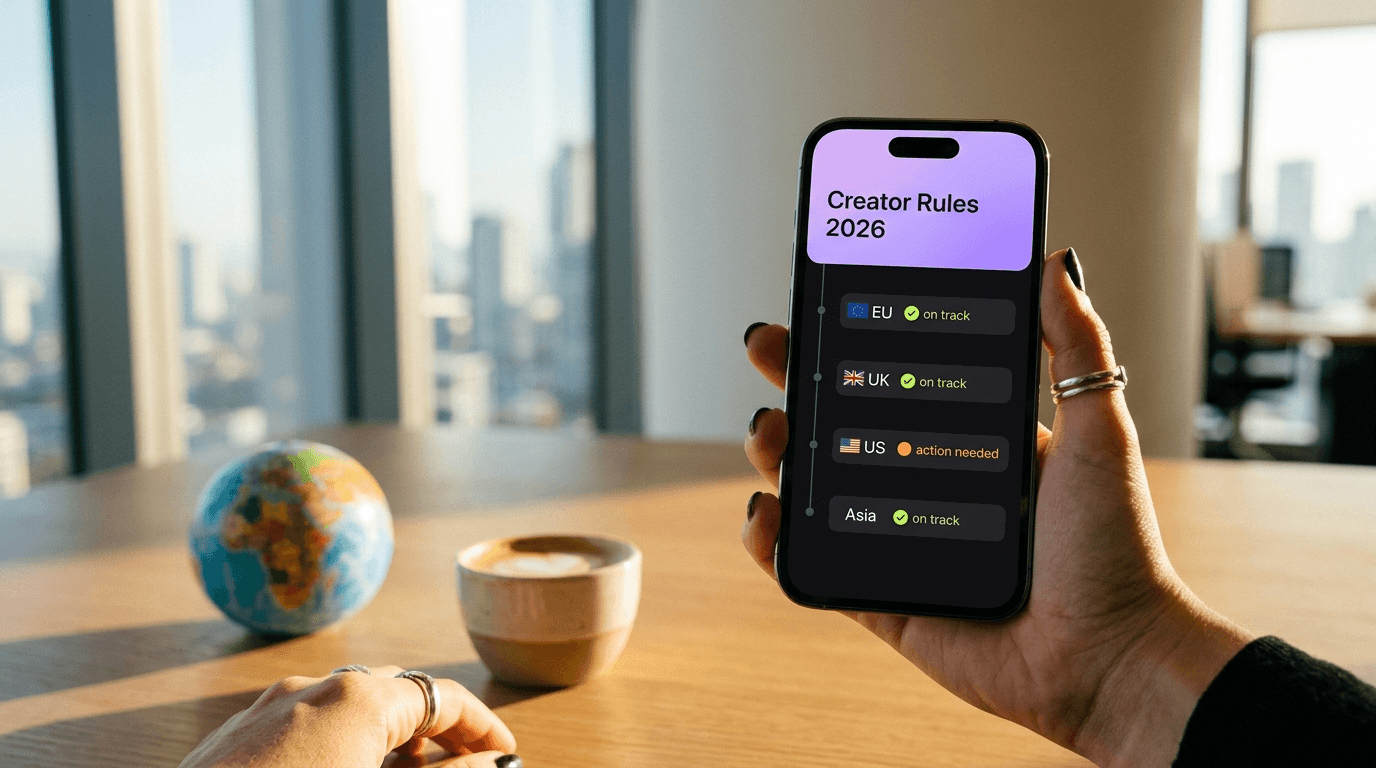
In 2026, regulations for creators will change dramatically worldwide: the EU AI Act becomes fully enforceable, New York protects influencers as employees, India implements data protection, and China tightens cross-border e-commerce rules. This article gives you a complete overview per quarter of what's changing and what you need to do — check the 5-step compliance checklist below for immediate action.
⚡ One calendar, all creator rules worldwide. Jump to the 5-step checklist, or try LinkDash for free.
Definitions: which regulations affect creators?
- EU AI Act
- In one sentence: European regulation that classifies AI systems by risk and imposes transparency obligations, with full enforcement from August 2026.
- DPDP Act (India)
- In one sentence: India's Digital Personal Data Protection Act regulates consent and data processing for anyone reaching Indian users.
- NY Influencer Law
- In one sentence: New York state law providing influencers with employment protections comparable to child actors, including contract and payment guarantees.
- UK Online Safety Act
- In one sentence: British law requiring platforms and creators to actively moderate illegal and harmful content, with significant fines for non-compliance.
- China Cross-Border E-Commerce Regulations
- In one sentence: Tightened Chinese rules for foreign sellers and influencers promoting products to Chinese consumers.
- FTC Endorsement Guidelines (US)
- In one sentence: American guidelines requiring transparent sponsorship disclosure for all forms of paid promotion.
Why is 2026 a turning point for creator regulation?
Short answer: Multiple major regulatory frameworks are coming into force simultaneously, making compliance inevitably complex for international creators.
The creator economy has operated in a relatively unregulated space for years. Platforms set the rules, and governments watched from the sidelines. That era ends in 2026. According to industry analyses, transparency is becoming the new standard: governments worldwide are demanding that creators clearly indicate when content is sponsored, when AI is used, and how data is collected.
This isn't coincidental timing. The COVID pandemic accelerated the creator economy, and governments have spent recent years preparing legislation. 2026 is the year that preparation turns into enforcement. For creators with international reach, this means you can no longer get by with knowing only your local rules — you need to understand where your audience is located and which jurisdictions apply.
What changes in Q1 2026 (January-March)?
Short answer: India's DPDP Act becomes fully operational, the FTC strengthens enforcement, and the EU AI Act prohibits the first category of AI systems.
India: DPDP Act full implementation
India's Digital Personal Data Protection Act comes into force with all implementing rules. For creators with Indian followers, this means:
- Explicit consent required for collecting personal data
- Clear privacy policy in understandable language
- Right to data deletion upon request
- Fines up to ₹250 crore (approximately €27 million) for major violations
United States: FTC strengthened enforcement
The Federal Trade Commission has announced stricter enforcement of influencer marketing. Specifically:
- "Clear and conspicuous" disclosure with every sponsored post
- Affiliate links must be explicitly marked as commercial
- No hidden sponsorship in "authentic" reviews
The FTC has been increasingly active in this space, with recent settlements against influencers serving as clear precedents for what's to come.
EU: AI Act prohibited practices take effect
From February 2026, the first "prohibited AI practices" under the EU AI Act take effect. This includes manipulative AI systems and social scoring — relevant for creators using AI tools for audience targeting or engagement optimisation.
What changes in Q2 2026 (April-June)?
Short answer: New York's influencer protection law takes effect, China tightens cross-border e-commerce rules, and the UK Online Safety Act receives new guidance.
New York: Influencer Labour Protection
New York State implements far-reaching protection for content creators:
- Written contracts mandatory for deals over $5,000
- Payment terms legally established (maximum 30 days)
- Intellectual property remains with creator unless explicitly transferred
- Minor creators receive the same protection as child actors
This applies to creators based in NY and to brands contracting NY-based creators — including from overseas.
China: Cross-Border E-Commerce 2.0
China's State Administration for Market Regulation (SAMR) implements new rules:
- Foreign influencers promoting Chinese products must be registered
- Product claims must be verifiable according to Chinese standards
- Livestream commerce gets real-time monitoring
UK: Online Safety Act guidance update
Ofcom publishes detailed guidance for creators under the Online Safety Act. Focus on:
- Age verification for certain content
- Proactive moderation of comments
- Reporting obligations at certain thresholds
What changes in Q3 2026 (July-September)?
Short answer: The EU AI Act becomes fully enforceable with all high-risk obligations, and multiple American states follow New York's example.
EU: AI Act full enforcement (August 2026)
This is the most important deadline for European creators. From 2 August 2026:
- All AI-generated content must be labelled as such
- Deepfakes and synthetic media require explicit disclosure
- AI tools for content creation fall under transparency obligations
- Platforms must implement AI detection
According to AI regulation analyses, tech leaders will need to make significant compliance adjustments. For creators, this means concretely: if you use AI for scripts, thumbnails, voice-overs or other content, you must make this known.
US: California and Illinois follow NY
Multiple states are introducing similar influencer protection laws. California's version may go further with:
- Mandatory escrow for major deals
- Cooling-off period for exclusivity contracts
- Transparency about algorithm impact on reach
What changes in Q4 2026 (October-December)?
Short answer: EU Digital Services Act gets expanded enforcement, India starts active enforcement, and the first major fines are expected.
EU: DSA expanded enforcement
The Digital Services Act, already in force since 2024, gets expanded enforcement capacity in Q4 2026:
- National supervisory authorities fully operational
- Cross-border enforcement coordination active
- First significant fines for platforms and major creators
India: DPDP Act first enforcement actions
After a year of implementation, India starts active enforcement. Expect:
- Warnings to international creators with Indian audiences
- Possible blocks of non-compliant services
- First fines for flagrant violations
Worldwide: First major precedents
Q4 2026 will likely be the quarter of the first high-profile enforcement actions. This creates precedents for how rules are applied in practice.
Comparison table: regulations by region
| Region | Key legislation | Effective date 2026 | Focus | Max. fine | Creator impact |
|---|---|---|---|---|---|
| EU | AI Act | August 2026 | AI transparency | €35 million or 7% revenue | High — AI content labelling mandatory |
| EU | DSA (expansion) | Q4 2026 | Platform responsibility | 6% global revenue | Medium — indirect via platforms |
| UK | Online Safety Act | Q2 2026 (guidance) | Content moderation | £18 million or 10% revenue | High — direct obligations |
| US (NY) | Influencer Labour Law | April 2026 | Employment law | Civil liability | High — contractual protection |
| US (Federal) | FTC Guidelines | Q1 2026 (strengthening) | Disclosure | $50,000+ per violation | High — every sponsored post |
| India | DPDP Act | Q1 2026 | Data protection | ₹250 crore (~€27M) | Medium-High — with Indian audience |
| China | SAMR E-Commerce Rules | Q2 2026 | Cross-border commerce | Blocking + fines | High — with Chinese market |
| Australia | Online Safety Amendment | Q3 2026 | Minor protection | AUD 500,000+ | Medium — specific content |
What does this mean for your type of creator business?
For creators with EU focus
Your primary concern is the EU AI Act. From August 2026, you must label every form of AI use in your content. This applies to AI-generated thumbnails, scripts written with ChatGPT, voice-overs with ElevenLabs, and AI-enhanced video editing. Start documenting your AI use now and implement a consistent labelling system.
For creators with American audience
The FTC strengthening affects you directly. Every sponsored post, every affiliate link, every gifted product must be disclosed "clear and conspicuous." "#ad" at the bottom of a caption is no longer sufficient — the disclosure must be visible without scrolling or clicking. If you work with American brands, prepare for stricter contractual requirements due to the NY legislation.
For creators with Asian reach
India and China require specific adjustments. For India: implement a DPDP-compliant privacy policy and consent mechanism. For China: consider whether direct promotion of products to Chinese consumers is worth the compliance burden. Many creators choose to serve Chinese markets indirectly through local partners.
For creators using AI tools
The EU AI Act affects you most. Make an inventory of all AI tools you use:
- Content generation (ChatGPT, Claude, Jasper)
- Image creation (Midjourney, DALL-E, Stable Diffusion)
- Video editing (Runway, Pika)
- Voice synthesis (ElevenLabs, Murf)
- Thumbnail optimisation (AI-powered A/B testing)
For each of these, you must be able to demonstrate that you label output as AI-generated where applicable.
For creators with minor audience
The UK Online Safety Act and similar legislation worldwide impose additional obligations for content aimed at minors. Age verification, strict moderation, and limited data processing are becoming the norm. Consider whether your target audience strategy needs adjustment.
5-step compliance checklist for 2026
- Map your geographic audience — Check your analytics: what percentage comes from EU, UK, US, India, China? This determines which regulations apply to you.
- Audit your AI use — Make a complete list of AI tools in your workflow. Determine per tool whether output requires labelling under the EU AI Act.
- Update your disclosure practice — Ensure sponsorship disclosures meet the strictest standard (FTC). "Clear and conspicuous" means: first 3 seconds of video, above the fold on posts.
- Review your contracts — If you work with American brands, expect stricter contractual requirements. Ensure your own contracts provide protection comparable to NY legislation.
- Implement privacy compliance — GDPR is the baseline, but DPDP (India) and other regimes may require additional consents. A good cookie/consent solution is essential.
⚡ Need to manage compliance information centrally?
With LinkDash you have one place for all your important links, disclaimers and privacy information. One bio link you can update as soon as regulations change — without having to visit 15 platforms.
Try LinkDash for free → no credit card · 5 minute setup
Edge cases and grey areas
"I only use AI for brainstorming, not for final content"
The EU AI Act focuses on AI-generated content that is publicly shared. If you use AI for idea generation but rewrite everything yourself, that probably falls outside the labelling obligation. However, do document your process in case of an audit.
"My audience is 95% domestic, why should I worry about India?"
You're right that prioritisation matters. Focus on the EU AI Act and GDPR. But: if that 5% grows or you ever want to expand, it's smart to set up privacy infrastructure to be scalable now.
"I'm a small creator, are they really going to enforce against me?"
Probably not first. But: the reputational damage of non-compliance can be greater than the direct fine. Moreover, some regulations (NY Influencer Law) require brands to only work with compliant creators — non-compliance can cost you deals.
"How do I label AI content on platforms that don't have a disclosure option?"
Textual disclosure in the content itself: "[AI-assisted]" in video descriptions, watermarks on AI-generated images, verbal disclosure in audio/video. The law requires disclosure, not a specific method.
"Am I subject to the NY law if I work from abroad with a NY brand?"
The NY Influencer Law protects creators in NY. If you're based elsewhere, you don't fall directly under it — but the brand you work with might. Expect American brands to impose stricter contractual requirements that follow the spirit of the law.
Disclaimer: This article provides general information about regulations and is not legal advice. Regulations change continuously and interpretations may differ by jurisdiction. Consult a legal specialist for advice specific to your situation.
Sources
- Eliassen Group — Key AI Regulations to Watch in 2026
- Yahoo Finance — 2026: Transparency Becomes a New Standard in the Creator Economy
- European Commission — EU AI Act Regulatory Framework
- FTC — Endorsement Guides
- India Ministry of Electronics and IT — Digital Personal Data Protection
Frequently asked questions
What is the EU AI Act?
The EU AI Act is a European regulation that classifies AI systems by risk and imposes transparency obligations, with full enforcement from August 2026.
What is India's DPDP Act?
India's Digital Personal Data Protection Act regulates consent and data processing for anyone reaching Indian users, with fines up to ₹250 crore (approximately €27 million).
What does the NY Influencer Law involve?
The New York state law provides influencers with employment protections comparable to child actors, including mandatory written contracts and payment guarantees for deals over $5,000.
What is the UK Online Safety Act?
The British Online Safety Act requires platforms and creators to actively moderate illegal and harmful content, with significant fines for non-compliance.
When does the EU AI Act become fully enforceable?
The EU AI Act becomes fully enforceable on 2 August 2026, when all high-risk obligations and transparency requirements for AI-generated content take effect.
Do I need to label AI use in my content?
Yes, from August 2026 under the EU AI Act you must label every form of AI use in your content, including AI-generated thumbnails, scripts, voice-overs and video editing.
What fines do I risk for non-compliance with the EU AI Act?
The maximum fine under the EU AI Act is €35 million or 7% of global annual turnover, depending on which amount is higher and the severity of the violation.
Does the NY Influencer Law apply to non-US creators?
The NY Influencer Law primarily protects creators based in New York. Creators based elsewhere don't fall directly under it, but American brands you work with might, which can lead to stricter contractual requirements.
How do I know which regulations apply to me?
Check your analytics to see where your audience is located. Regulations usually apply based on where your audience is, not just where you're based.
What is the most important compliance action for 2026?
Make a complete audit of your AI use and implement a consistent labelling system for AI-generated content, as the EU AI Act is the most significant new obligation for European creators.
Will small creators also be enforced against?
Small creators are probably not the first enforcement priority, but non-compliance can cost you deals because brands increasingly only want to work with compliant creators.
Where can I find more information about creator regulations?
Official sources include the European Commission for the EU AI Act, the FTC for American disclosure rules, and national supervisory authorities such as the ICO (UK) or your local data protection authority for GDPR-related matters.
Want to learn more about staying compliant as a creator? Also read our article on what to check in creator contracts and how to create a privacy policy as a creator.
Max
Content Specialist at LinkDash
Max is Content Specialist at LinkDash with a focus on the German-speaking market. He writes about GDPR-compliant link-in-bio strategies, content marketing and how European creators reach their audience without sacrificing privacy.
Ready to get started?
Create your own link-in-bio page for free with iDEAL, Wero and 100+ templates.
Start free