
European DSA enforcement intensifies: what the Snapchat and adult-platform measures mean for creators
March 2026 marks a turning point in DSA enforcement. The European Commission places Snapchat and multiple adult platforms under direct supervision. What does this mean for UK and European creators? A technical analysis of the new regulatory reality.
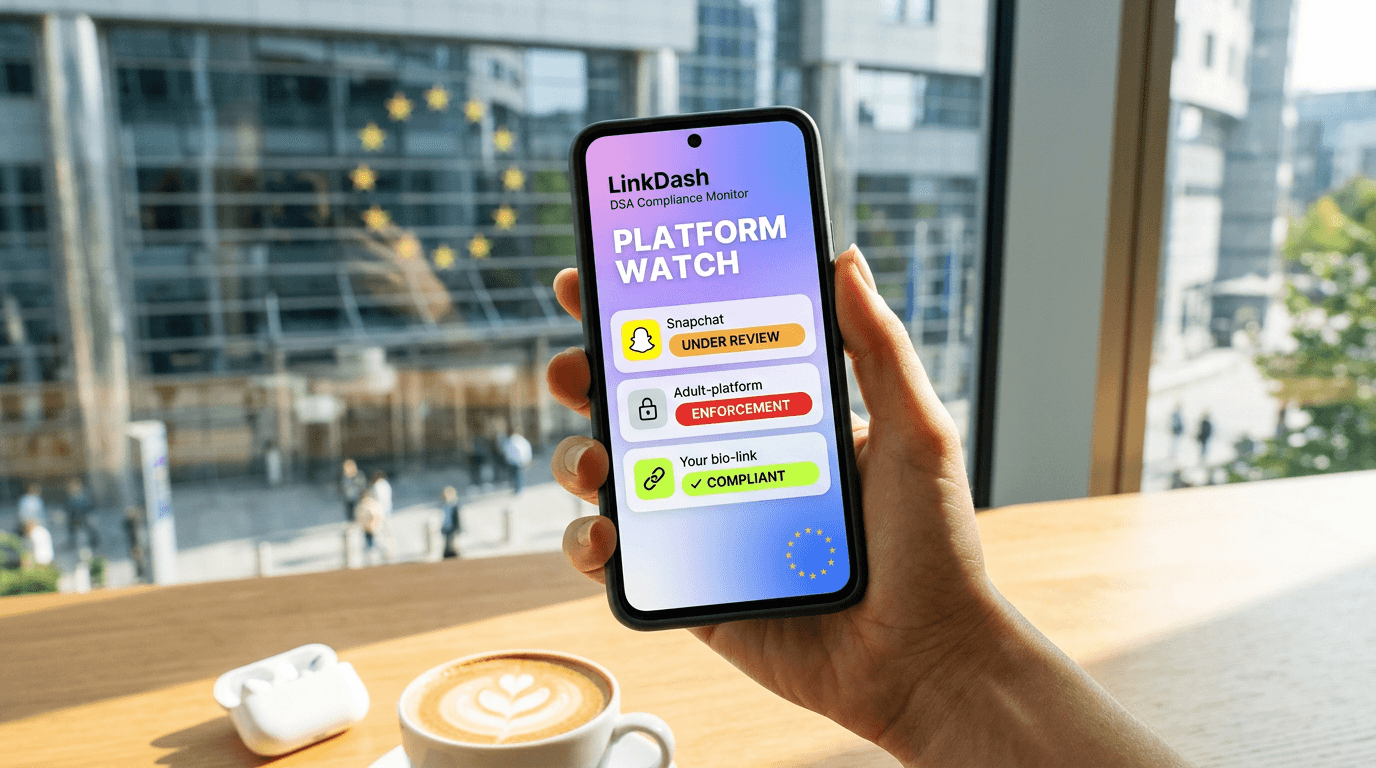
The European Digital Services Act (DSA) is no longer a paper tiger. In March 2026, the European Commission placed Snapchat and multiple adult platforms under heightened supervision, with direct consequences for how you distribute content and generate income as a creator. Scroll to the 5-step checklist to prepare.
⚡ DSA enforcement now directly affects creators. Jump to the 5-step checklist, or try LinkDash for free.
Key concepts: DSA terminology for creators
- Digital Services Act (DSA)
- In one sentence: European legislation that requires online platforms to ensure transparency, content moderation and user protection — with fines up to 6% of global turnover for violations.
- Very Large Online Platform (VLOP)
- In one sentence: A platform with more than 45 million monthly active users in the EU, which falls under direct supervision of the European Commission.
- Designated status
- In one sentence: The official designation by the Commission through which a platform receives VLOP status and must comply with all DSA obligations within four months.
- Systemic risk assessment
- In one sentence: Mandatory analysis that VLOPs must conduct to map the risks of their services to minors, democracy and public health.
- Algorithmic transparency
- In one sentence: The requirement for platforms to explain how their recommendation algorithms work and to offer users a non-personalised alternative.
What happened in March 2026?
Short answer: The European Commission officially designated Snapchat as a Very Large Online Platform (VLOP) and initiated formal enforcement proceedings against multiple adult content platforms for non-compliance with DSA obligations around age verification and minor protection.
The enforcement wave of March 2026 comes as no surprise to anyone following DSA implementation. What is new: the speed and breadth of action. According to analysis by the Atlas Institute, 2026 marks the moment when "DSA enforcement becomes the new regulatory shock" for platforms that assumed European legislation would remain toothless.
Snapchat exceeded the 45 million EU user threshold and now has four months to comply with all VLOP obligations. For adult platforms, the situation is more urgent: the Commission is actively investigating whether platforms like Pornhub, XVideos and Stripchat have implemented adequate age verification — a requirement that directly affects how adult creators can offer their content.
For UK-based creators, the picture is equally relevant. While the UK operates under its own Online Safety Act framework post-Brexit, any platform serving EU users must comply with DSA regardless of where creators are based. If your audience includes European viewers, these rules apply to your distribution channels.
Why is enforcement only gaining momentum now?
Short answer: The DSA has been fully in force since February 2024, but the Commission needed time to build capacity, collect data and create legal precedents with the first cases against X and TikTok.
The Panoptykon Foundation — a Polish digital rights organisation — presented a brief to the European Parliament in February 2026 that clearly summarises the state of play: platforms have largely engaged in compliance theatre over the past two years, while fundamental problems around minor protection remained unresolved.
The first enforcement actions against X (formerly Twitter) and TikTok in 2024-2025 served as test cases. Now that the Commission has gained legal experience and its Digital Services Coordinator network is functioning, the pace is escalating. Expect not one or two, but dozens of formal procedures in 2026.
The UK's Competition and Markets Authority (CMA) and Ofcom have been watching these proceedings closely. The cross-pollination between EU enforcement patterns and UK regulatory approaches means creators operating across both markets face converging compliance expectations.
Which platforms are now under heightened DSA supervision?
Short answer: As of March 2026, 24 platforms have been designated as VLOPs, including all major social media platforms, search engines, marketplaces and now Snapchat. Additionally, investigations are underway into platforms not yet formally designated but serving European users.
| Platform | VLOP status | 2026 enforcement action | Creator impact |
|---|---|---|---|
| Snapchat | Newly designated (March 2026) | Four-month compliance deadline | Spotlight algorithm must become more transparent, potentially less viral reach |
| TikTok | VLOP since April 2023 | Ongoing procedure on minor protection | Stricter age-gating, For You Page adjustments |
| VLOP since April 2023 | Investigation into ad targeting | Branded content rules becoming stricter | |
| YouTube | VLOP since April 2023 | No active procedure | More transparency required on demonetisation decisions |
| Pornhub | Under investigation | Formal procedure on age verification | Mandatory ID verification for all EU users looming |
| OnlyFans | Non-VLOP, but DSA obligations apply | Preventive compliance measures | Payment verification already tightened, content rules stricter |
| X (Twitter) | VLOP since April 2023 | Multiple ongoing procedures | Monetisation features limited for non-verified accounts |
| VLOP since April 2023 | No active procedure | B2B creators relatively unaffected |
What does intensified DSA enforcement concretely mean for creators?
Short answer: More transparency about why your content is or isn't recommended, stricter rules around sponsored content, and for adult creators potentially fundamental changes in how you can distribute and monetise your work.
Scenario 1: Lifestyle creator on Instagram and Snapchat
You notice your Reels and Stories go viral less often than before. That's no coincidence: DSA requires platforms to offer users a non-personalised feed alternative. The more people activate that option, the less the algorithm pushes your content to new viewers. Compensate by strengthening your owned channels — newsletter, bio link — that you fully control.
Scenario 2: Adult creator on OnlyFans or similar platform
The enforcement wave explicitly targets minor protection for adult content. Expect stricter verification requirements, potentially geographic restrictions, and platforms pre-emptively removing content to avoid fines. Diversify your income streams now, before a sudden policy change affects your main platform. UK creators should note that the Online Safety Act imposes similar age verification requirements domestically.
Scenario 3: YouTube educator with sponsored content
DSA's advertising transparency requirements mean you must label sponsored content even more clearly. YouTube must also better explain why specific videos are or aren't monetised. That's a double-edged sword: more insight, but also more responsibility for correct disclosure. The Advertising Standards Authority (ASA) guidance in the UK already requires clear #ad labelling — DSA enforcement pushes platforms to verify this systematically.
Scenario 4: TikTok creator targeting Gen Z
TikTok faces the heaviest DSA pressure due to its young user base. Expect more age-gating on content, potential restrictions on which topics you can cover, and For You Page adjustments that make virality harder for new creators. The platform's transparency reports now show significantly higher content moderation rates for EU users.
Scenario 5: B2B creator on LinkedIn
Relatively safe territory. LinkedIn's business focus and older user base make it less interesting for DSA enforcement around minor protection. General transparency requirements still apply, but these affect B2B content less severely.
5-step checklist: prepare for DSA enforcement
- Audit your platform dependency: List all platforms where you're active and categorise them by VLOP status. Platforms under active enforcement have higher risk of sudden policy changes.
- Strengthen your owned channels: Email list, own website, bio link that you fully control. The less dependent on platform algorithms, the more resilient against regulatory shifts.
- Review your disclosure practices: Check whether all your sponsored content is correctly labelled according to the strictest interpretation. Platforms will enforce more strictly to avoid their own fines.
- Document your content decisions: If a platform removes or demonetises content, you have a right to explanation under DSA. Keep your own records of what you post and why.
- Diversify revenue: Don't rely on one monetisation channel. Combine platform income with direct sales, coaching, or other services you can offer independently of platform policy.
⚡ Want to be less dependent on platform algorithms?
LinkDash gives you a bio link you fully control, with built-in analytics and payment integration. Your audience, your data, your rules.
Try LinkDash for free → no credit card · 5-minute setup
Edge cases and grey areas
What if my platform isn't a VLOP yet but serves EU users?
Non-VLOPs must also comply with basic DSA obligations: transparent terms, reporting mechanisms for illegal content, and cooperation with national authorities. The difference is they don't fall under direct Commission supervision. But: if a platform grows towards the 45 million threshold, designation can follow quickly — as Snapchat now experiences.
Does DSA apply to platforms outside the EU?
Yes, if they offer services to EU users. They must appoint a legal representative in the EU. If they refuse, they can be blocked — though that's a nuclear option the Commission doesn't deploy lightly. For UK-based platforms, this creates a complex compliance landscape: domestic Online Safety Act requirements plus DSA obligations for any EU audience.
Can I file a DSA complaint as a creator?
Indirectly. You can file complaints with the Digital Services Coordinator of your member state. In Ireland, that's Coimisiún na Meán; in Germany, the Bundesnetzagentur. They can initiate investigations. Additionally, DSA requires platforms to have internal complaint mechanisms you can use as a creator.
What if a platform removes my content "due to DSA compliance"?
You have a right to a reasoned explanation. If you believe the removal was unjustified, you can appeal internally and then to a certified out-of-court dispute resolution body. Note: this costs time and energy, so preventively labelling correctly and staying within guidelines is more efficient.
What about AI-generated content under DSA?
DSA requires platforms to have policies around AI content, but specific rules are still developing. The AI Act — running in parallel — will provide more clarity here. For now: be transparent if you use AI in your content creation. The EU's AI Act watermarking requirements for synthetic content will likely create new disclosure obligations by 2027.
Disclaimer: this information is for educational purposes and not legal advice. DSA interpretation evolves; consult a specialist for situation-specific questions.
Sources
- Atlas Institute — DSA Enforcement is the New Regulatory Shock: Mapping the First Wave of Platform Risk in 2026
- Panoptykon Foundation — Brief for the Hearing at the European Parliament on DSA Enforcement and the Protection of Minors
- European Commission — Designated very large online platforms and search engines under the DSA
- Ofcom — Online Safety Regulation in the UK
- EUR-Lex — Regulation (EU) 2022/2065 (Digital Services Act full text)
- ASA — Recognising Ads: Social Media Guidance
Frequently asked questions
What is the Digital Services Act (DSA)?
The Digital Services Act is European legislation that requires online platforms to ensure transparency, content moderation and user protection — with fines up to 6% of global turnover for violations. The law has been fully in force since February 2024 for all platforms offering services to EU users.
What is a Very Large Online Platform (VLOP)?
A Very Large Online Platform is a platform with more than 45 million monthly active users in the EU. VLOPs fall under direct supervision of the European Commission and must meet additional obligations, such as systemic risk assessments and external audits.
What does designated status mean under the DSA?
Designated status is the official designation by the European Commission through which a platform receives VLOP status. After designation, the platform has four months to comply with all DSA obligations. Snapchat received this status in March 2026.
What is algorithmic transparency under the DSA?
Algorithmic transparency is the requirement for platforms to explain how their recommendation algorithms work. Additionally, VLOPs must offer users a non-personalised alternative for their feed or timeline.
Why does DSA enforcement focus on minor protection?
The DSA contains specific provisions for the protection of minors online. Platforms must demonstrate that their services do not harm young people, through age verification, content restrictions and adjustments to recommendation algorithms. The Commission views this as a priority.
Which adult platforms are being investigated under the DSA?
The European Commission is investigating multiple adult content platforms for compliance with DSA obligations, particularly around age verification. Specific platform names in ongoing investigations are not always made public until formal procedures begin.
Can I file a DSA complaint as a creator?
Yes, you can file complaints with the Digital Services Coordinator of your member state. Additionally, DSA requires platforms to have internal complaint mechanisms that you can use directly.
What are my rights if a platform removes my content?
Under DSA, you have the right to a reasoned explanation of why your content was removed or moderated. You can appeal internally to the platform and then to a certified out-of-court dispute resolution body if you disagree with the decision.
How does DSA enforcement affect the reach of my content?
DSA requires platforms to offer non-personalised feed alternatives. The more users switch to these, the less the algorithm pushes new viewers to your content. This makes owned channels — such as a newsletter or bio link — more important for your reach.
Does the DSA apply to platforms outside the European Union?
Yes, the DSA applies to all platforms offering services to users in the EU, regardless of where the platform is based. Non-EU platforms must appoint a legal representative in the EU.
How can I prepare for DSA enforcement as a creator?
Strengthen your owned channels to be less dependent on platform algorithms, review your disclosure practices for sponsored content, and diversify your income streams. Also document your content decisions so you can demonstrate you're acting in good faith.
What is the difference between DSA and the AI Act?
The DSA regulates online platforms and their responsibilities around content and user protection. The AI Act specifically regulates artificial intelligence systems and their risks. Both laws complement each other but have different focus areas and obligations.
The 2026 DSA enforcement wave isn't a one-off event, but the beginning of structurally stricter regulation of online platforms in Europe. As a creator, you can be cynical about it, or see it for what it also is: an opportunity to strengthen your independence. Platforms under pressure become unpredictable. Your own channels don't.
Want to know more about how to future-proof your creator business? Also read our analysis of the EU Digital Identity Wallet and what it means for creators.
Max
Content Specialist at LinkDash
Max is Content Specialist at LinkDash with a focus on the German-speaking market. He writes about GDPR-compliant link-in-bio strategies, content marketing and how European creators reach their audience without sacrificing privacy.
Ready to get started?
Create your own link-in-bio page for free with iDEAL, Wero and 100+ templates.
Start free