
Checkout.com achieves Forrester Leader status: what it means for high-volume EU creators
Checkout.com has been named a Leader in Forrester's merchant payment providers report. What does this mean for European creators processing thousands of transactions monthly? Analysis of enterprise-grade payment solutions for the creator economy.
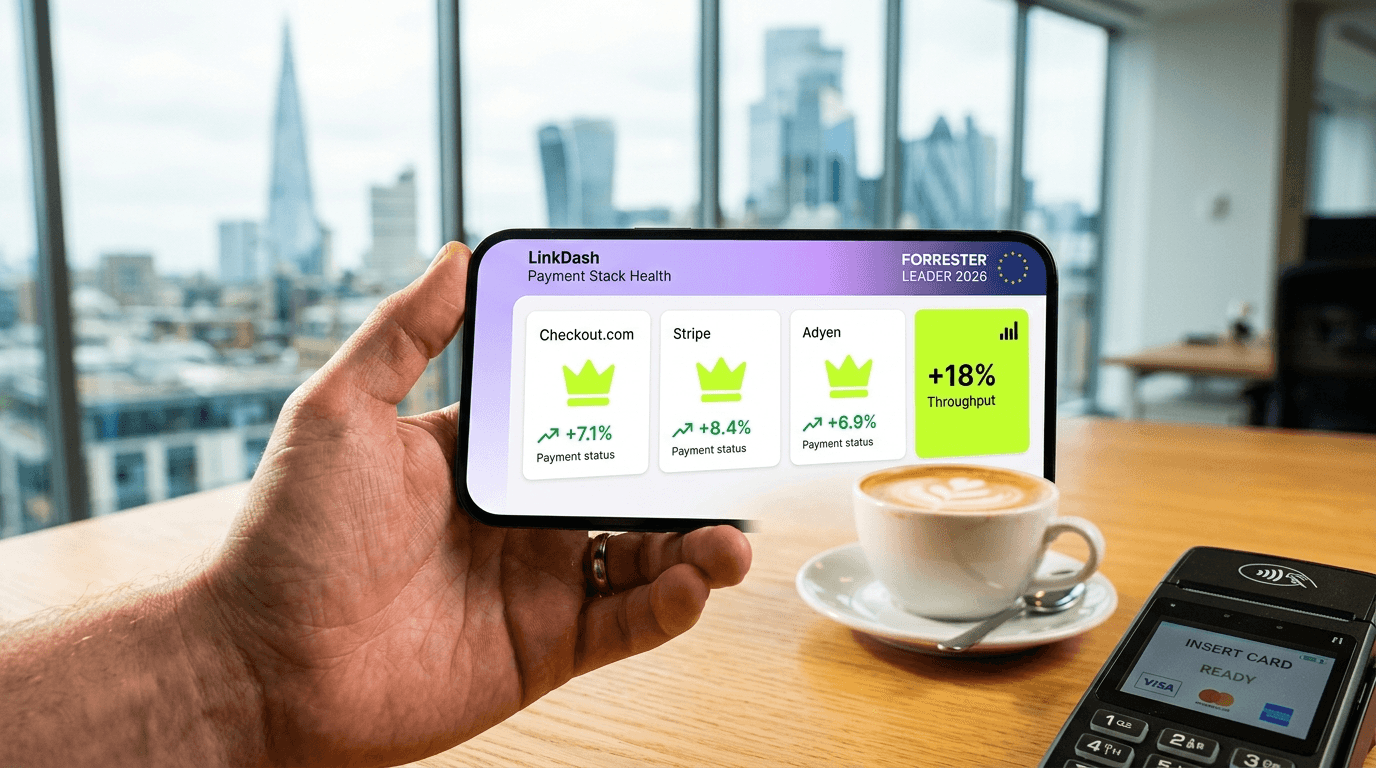
Checkout.com achieved the coveted Leader status in the 2024 Forrester Wave report for merchant payment providers. For European creators processing thousands of transactions monthly, this means enterprise-grade payment infrastructure is becoming more accessible — but the question remains whether your volume justifies the switch. Scroll to the 5-step checklist to determine if enterprise payments are right for you.
⚡ Enterprise payments now accessible for creators. Jump to the 5-step checklist, or try LinkDash free.
Key terms explained
- Forrester Wave
- In one sentence: An independent research report that evaluates technology vendors on strategy, market presence, and product quality — the "Michelin stars" of enterprise software.
- Leader status
- In one sentence: The highest classification in a Forrester Wave, awarded to companies that score above average on both current performance and future vision.
- Payment Service Provider (PSP)
- In one sentence: A company that provides the technical infrastructure to accept online payments, from credit cards to local methods like SEPA Direct Debit and Apple Pay.
- Enterprise-grade
- In one sentence: Software built for large organisations with high requirements for uptime, scalability, compliance, and support.
- High-volume creator
- In one sentence: A creator who processes more than €10,000 in monthly transactions or receives more than 500 individual payments.
What is the Forrester Wave and why should you care?
Short answer: The Forrester Wave is the most cited independent research for enterprise software. A Leader status means a company has been validated by independent analysts as top-tier — not a marketing claim, but external verification.
For the average creator running an Etsy shop or coaching practice, this report honestly isn't relevant. But once your transaction volumes grow to thousands of pounds or euros per month, your priorities shift. Suddenly, matters like chargebacks, multi-currency support, and enterprise-level uptime become critical to your operations.
Checkout.com's Leader status in the Forrester Wave 2024 places the company alongside established names like Adyen and Stripe. This is notable because Checkout.com traditionally focused on enterprise clients like Deliveroo and Klarna, but is now actively entering the creator and SMB market.
According to Forrester's methodology, Leaders must demonstrate excellence across 28 criteria spanning current offering, strategy, and market presence. For UK creators specifically, Checkout.com's strong presence in London (where it's headquartered) means potentially better support and understanding of local payment preferences like Open Banking and Faster Payments.
How does Checkout.com compare to Stripe, Adyen, and local providers?
Short answer: Checkout.com offers similar functionality to Stripe and Adyen, but with a focus on large volumes and lower fees at scale. For creators under €50,000/month, the difference is often marginal.
| Aspect | Checkout.com | Stripe | Adyen | PayPal Commerce |
|---|---|---|---|---|
| Primary target audience | Enterprise, high-growth | Startups to enterprise | Enterprise | SMB, creators |
| Minimum volume required | Yes (variable) | No | Yes (±€1M/year) | No |
| European credit card fee | 1.5% + €0.20 (negotiable) | 1.5% + €0.25 | Interchange++ (variable) | 2.9% + fixed fee |
| UK card fee | 1.5% + £0.20 | 1.5% + £0.20 | Interchange++ | 2.9% + £0.30 |
| Forrester Wave 2024 | Leader | Leader | Leader | Strong Performer |
| Multi-currency payout | Yes, 150+ currencies | Yes, 135+ currencies | Yes, 150+ currencies | Limited |
| Local EU support | English, dedicated AM | English, chat/email | Multi-language available | Multi-language |
| Chargeback protection | Advanced, ML-based | Radar (ML-based) | RevenueProtect | Basic |
What stands out: the actual fee differences between these providers are marginal for most creators. The real difference lies in negotiating power at volume, quality of fraud detection, and the extent to which the provider grows with your business.
For which type of creator is enterprise-grade payments relevant?
Short answer: Only if you process €25,000+ monthly, have international customers, or regularly deal with chargebacks. For 95% of European creators, Stripe or a local provider is more than sufficient.
The course creator with international sales
You sell online courses to a global audience. Customers pay in dollars, euros, and pounds. With Checkout.com, you can offer local payment methods in each country and receive settlements in your preferred currency without intermediary FX fees. At €50,000/month in international sales, this can save €500-1,000/month.
The SaaS founder with subscriptions
You have a membership site with 2,000+ paying members. Recurring billing, dunning management (automatically retrying failed payments), and churn prevention become critical. Enterprise PSPs offer more advanced tooling here than basic providers.
The e-commerce creator with physical products
You sell merch or physical products alongside digital content. Chargeback risks are higher with physical goods. Advanced fraud detection can make the difference between operating profitably or losing money to fraudulent orders.
The agency owner with high-ticket sales
You invoice clients €5,000-50,000 per project. At these amounts, credit card fees become significant (€75-750 per transaction at 1.5%). Enterprise rates or interchange++ pricing can save thousands of euros per year.
The small creator (honest advice)
You earn €500-5,000/month with your creator business. Honestly? Don't focus your energy on payment optimisation. The difference between providers is maximum €20-50/month. That time is better spent creating content or growing your audience.
5-step checklist: is enterprise-grade payments right for you?
- Calculate your monthly transaction volume — Add up all your income from digital products, services, and physical sales. Under €10,000/month? Enterprise solutions are overkill.
- Analyse your geographic distribution — More than 30% international customers? Multi-currency support becomes valuable. Only local customers? A regional provider with local payment methods is probably optimal.
- Check your chargeback ratio — More than 0.5% chargebacks? Advanced fraud tools become essential. Under 0.1%? Basic protection suffices.
- Evaluate your growth trajectory — Do you expect to double within 12 months? Choose a provider that scales with you. Stable business? Optimise for your current situation.
- Compare total costs — Request quotes from at least 3 providers. Note: not just transaction fees, but also setup costs, monthly fees, and hidden costs like currency conversion.
⚡ All your payment links in one place, hassle-free?
LinkDash integrates with your existing payment provider — Stripe, PayPal, or whichever you use. One bio link for all your products, automatic affiliate tracking, and analytics you actually understand.
Try LinkDash free → no credit card · 5 minutes setup
What does Checkout.com's Leader status mean in practice?
Short answer: More competition in the enterprise payments market, which ultimately leads to better terms for high-volume creators. Immediate action isn't necessary.
The Forrester recognition validates what the market already knew: Checkout.com is a serious player alongside Stripe and Adyen. For creators, this means:
- More negotiating power — With three comparably strong enterprise providers, you can negotiate better terms.
- Innovation pressure — Competition forces all players to deliver better products and lower prices.
- Legitimisation of the creator market — That enterprise providers actively target creators proves the creator economy is being taken seriously.
At the same time: for most European creators, little changes in the short term. Local providers remain the best choice for domestic payments, Stripe for international scale, and enterprise solutions remain the domain of the top 1% by volume.
For UK-based creators specifically, the post-Brexit regulatory environment means some additional considerations. While Checkout.com maintains full FCA authorisation and can process both UK and EU payments seamlessly, creators selling to both markets should verify their chosen provider handles the UK-EU payment corridor efficiently.
Edge cases: when to switch and when not to?
You're at €15,000/month and growing fast
Start conversations with enterprise providers now to understand their onboarding process. Proactively ask for volume discounts from your current provider — often you'll get better terms without switching.
You have one big client representing 80% of your revenue
Enterprise-grade payments is less relevant here than client diversification. Focus first on reducing concentration risk before optimising payment infrastructure.
You're considering international expansion
Multi-currency support becomes important then, but start with Stripe's standard offering before looking at Checkout.com or Adyen. The complexity of enterprise onboarding is only worth it with proven international demand.
You have high chargeback rates (>1%)
This is a serious problem that justifies advanced fraud tools — regardless of your volume. But first investigate why chargebacks are so high. Often the cause lies in unclear product descriptions or poor customer service, not your PSP.
You're currently paying more than 2.5% average fee
This is too high for virtually any business. Before looking at enterprise solutions: check whether your current provider isn't simply too expensive. Stripe sits around 1.5-1.8% for European cards.
Disclaimer: Payment optimisation is complex and dependent on your specific situation. The scenarios above are general guidelines, not financial advice. Consult with an accountant or financial advisor for decisions that significantly impact your cash flow.
Disclaimer and sources
This article is written for informational purposes and does not constitute financial or legal advice. Fee structures and product offerings may change. Always verify current terms with the relevant providers.
Sources:
- Clear Function: Stripe vs Adyen 2026 Comparison
- Forrester Research — The Forrester Wave methodology
- Checkout.com — Official website and pricing
- Stripe UK — Pricing page
- FCA — Payment Services Authorisation
Frequently asked questions
What is the Forrester Wave?
The Forrester Wave is an independent research report that evaluates technology vendors on strategy, market presence, and product quality — the "Michelin stars" of enterprise software.
What does Leader status mean in the Forrester Wave?
Leader status is the highest classification in a Forrester Wave, awarded to companies that score above average on both current performance and future vision.
What is a Payment Service Provider (PSP)?
A Payment Service Provider is a company that provides the technical infrastructure to accept online payments, from credit cards to local methods like SEPA Direct Debit and Apple Pay.
What does enterprise-grade mean for payment providers?
Enterprise-grade means software built for large organisations with high requirements for uptime, scalability, compliance, and support.
When are you a high-volume creator?
A high-volume creator processes more than €10,000 in monthly transactions or receives more than 500 individual payments.
What does Checkout.com cost for European creators?
Checkout.com charges approximately 1.5% + €0.20 for European credit cards, but rates are negotiable at volume. Exact pricing requires a quote request.
Is Checkout.com better than Stripe for European creators?
Not necessarily. Stripe offers excellent documentation, easy integration, and competitive rates for most creators. Checkout.com becomes interesting at high volumes (€25,000+/month) or significant international sales where negotiated rates make a meaningful difference.
What is the difference between Stripe and Checkout.com?
Stripe targets the full spectrum from startups to enterprise with extensive developer tools. Checkout.com focuses primarily on high-growth and enterprise clients with emphasis on volume discounts and advanced fraud prevention.
Do I need a minimum volume for Checkout.com?
Yes, Checkout.com has minimum volume requirements that vary by region and use case. For most creators, this is a barrier — ask their sales team for specific requirements.
When should I switch to an enterprise payment provider?
Consider enterprise solutions when: monthly volume exceeds €25,000, more than 30% of customers are international, chargeback ratios exceed 0.5%, or when your current provider is limiting your growth.
What are chargebacks and why are they important?
Chargebacks are reversals when a customer disputes a payment with their bank. High chargeback ratios (>1%) can lead to higher fees, account restrictions, or even account closure by your PSP.
Can I use multiple payment providers simultaneously?
Yes, many larger creators use multiple PSPs: for example, a local provider for domestic payments, Stripe for international cards, and an enterprise provider for specific high-volume use cases. This does require more administrative overhead.
Want to manage all your payment links and products from one central place? Try LinkDash free — works with any payment provider you already use.
Related articles:
Max
Content Specialist at LinkDash
Max is Content Specialist at LinkDash with a focus on the German-speaking market. He writes about GDPR-compliant link-in-bio strategies, content marketing and how European creators reach their audience without sacrificing privacy.
Ready to get started?
Create your own link-in-bio page for free with iDEAL, Wero and 100+ templates.
Start free