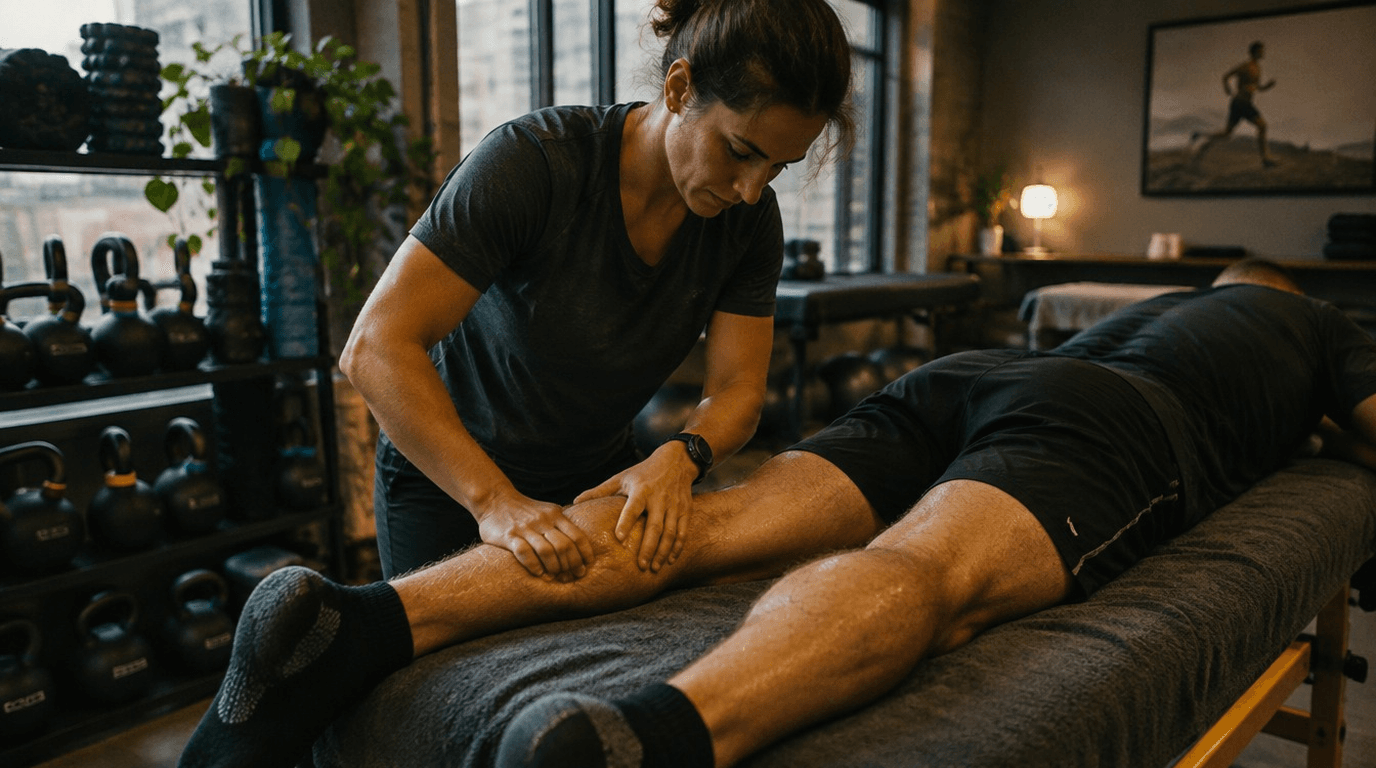
A bio-link for sports massage therapists bundles your treatment menu, online bookings and direct payments on one mobile page that athletes scan after training or competition. This eliminates WhatsApp chaos and missed appointments during busy seasons. Jump to the 5-step checklist to get started today.
⚡ One QR code for your entire practice. Jump to the 5-step checklist, or try LinkDash free.
What is a bio-link for sports massage therapists?
- Bio-link
- In one sentence: A mobile landing page behind one short URL or QR code, where you bundle all relevant links, booking options and payments.
- Sports massage
- In one sentence: Massage focused on athletes, emphasising performance improvement, recovery and injury prevention — often delivered by qualified sports therapists.
- Sports therapist
- In one sentence: A health professional who treats sport-related complaints through massage, taping, exercise therapy and advice — often registered with professional bodies like the Society of Sports Therapists (SST) or Complementary & Natural Healthcare Council (CNHC).
- Open Banking payments
- In one sentence: Bank-to-bank payment systems (like Wero in the EU or Open Banking in the UK) that let clients pay directly from their banking app without sharing card details or IBANs.
- Stripe / Square
- In one sentence: Payment processors popular with UK therapists, enabling card payments, bank transfers and Apple Pay with transaction fees around 1.4-2.9%.
For sports massage therapists, a bio-link works differently than for lifestyle influencers. Your clients are athletes who want to book, pay or check your qualifications quickly after training or a match. They're standing by the pitch, sweaty, scrolling on their phone, with no patience for five clicks.
A smart bio-link solves this by bundling everything on one scannable page: your treatment menu with prices and session duration, direct booking button, payment options, reviews and your professional registrations. One QR code on your business card, flyer or club noticeboard replaces endless WhatsApp messages.
Why do sports massage therapists need a bio-link?
Short answer: Because you work with seasonal peaks, returning clients and location changes — situations where one central, mobile hub saves you hours per week.
Sports massage therapists operate in a unique niche. You're not a hairdresser with a fixed chair, but work at changing locations: at the club, at events, at clients' homes or in your own practice. Your clients are often loyal athletes who return every fortnight, but also occasional marathon runners who need you once a year.
Without a central hub, chaos ensues:
- WhatsApp messages get buried under team chats
- Athletes forget your number after the season ends
- Payments via bank transfer feel unprofessional for club partnerships
- Your qualifications are unfindable when a club wants to verify them
- Seasonal promotions only reach your existing follower group
A bio-link solves each of these problems with one permanent URL you share everywhere.
What elements should a sports massage bio-link contain?
Short answer: Treatment menu, booking integration, payment options, qualifications, reviews and seasonal promotions — in that priority order.
Treatment menu with prices and session duration
Athletes want to know upfront what they're paying and how long a session lasts. No surprises, no "price on request". A clear menu also prevents no-shows: those who see the investment beforehand take the appointment more seriously.
Effective structure for your menu:
- Sports massage basic — 30 min — £35
- Sports massage extended — 60 min — £55
- Injury treatment — 45 min — £50
- Pre-event massage — 20 min — £25
- Post-event recovery — 45 min — £45
- Taping (kinesiology tape) — per application — £15
Place this menu directly visible on your bio-link, not behind an extra click. LinkDash supports price lists as a native block, so athletes scroll and immediately see what you offer.
Online booking integration for returning athletes
Returning clients are your bread and butter. A runner who comes every fortnight for maintenance massage, a football team that visits monthly — you don't want to lose these clients to scheduling hassle.
Integrate your booking system directly into your bio-link:
- Calendly — free up to 1 event type, then £10/month
- Fresha — popular with UK therapists, free with payment processing
- Square Appointments — free for individuals, integrates with Square payments
- Acuity Scheduling — powerful, from £16/month
Many UK sports therapists choose Fresha for its zero subscription cost and built-in payment processing. You embed the booking link in your bio-link, so athletes claim a slot with two taps.
Payment options for professional transactions
After a treatment, an athlete wants to pay and leave. Cash is outdated and inconvenient. Bank transfers work but feel informal for business partnerships. Modern payment processors offer professional alternatives.
Stripe is the standard for UK service providers: clients pay via card or Apple Pay, you receive funds within days. Transaction fees around 1.4% + 20p for UK cards.
Square combines payments with booking, making it popular for mobile therapists. The Square Reader lets you take card payments at events or home visits.
Open Banking payments are emerging as an alternative — clients pay directly from their bank app, similar to how Wero works in mainland Europe. Services like TrueLayer and Yapily enable this, with lower fees than card payments.
For your bio-link: add a payment button linking to your Stripe payment page or integrate payments directly through your booking system. After treatment, the athlete scans your QR code, pays, done.
Qualifications and professional registrations
Sports clubs and insurers want to know you're qualified. Make your registrations findable:
- SST — Society of Sports Therapists
- CNHC — Complementary & Natural Healthcare Council
- SMA — Sports Massage Association
- ISRM — Institute of Sport and Remedial Massage
- Insurance — Professional liability coverage (required for most club work)
Link directly to your registration page or display your registration number. This builds trust and speeds up partnerships with clubs.
Reviews and testimonials
Athletes trust experiences from other athletes. Embed your Google Reviews or link to your Facebook reviews. Concrete results work best: "After three sessions with [name] I could train pain-free again for the London Marathon."
How does collaboration with sports clubs work via QR flyers?
Short answer: Print your bio-link as a QR code on flyers, hang them in changing rooms and by physio corners — members scan and book directly without club committee involvement.
Sports clubs are goldmines for sports massage therapists. One football club has dozens of potential clients. But club committees are busy and respond slowly to partnership proposals.
The QR flyer approach works faster:
- Design an A5 flyer with your photo, specialisation and QR code to your bio-link
- Ask permission to hang flyers in the changing room (usually no problem)
- Add a club-specific discount: "10% off for Arsenal FC members"
- Track scans via your bio-link analytics to see which clubs convert
With LinkDash you create separate links per club, so you know exactly how many bookings come from each changing room. That data helps when renewing partnerships.
Events and competitions
Marathons, triathlons, cycling events — these are hotspots for sports massage. But arranging on-site bookings is chaotic. Solution: share your bio-link via the event newsletter or social media beforehand.
"Running the London Marathon on Sunday? Book your post-race massage now via [link]." Participants book a time slot, pay in advance, and only need to show up on the day.
| Element | Purpose | Priority | Example | Conversion impact | Setup time |
|---|---|---|---|---|---|
| Treatment menu | Price/duration transparency | Essential | "Sports massage 60 min — £55" | High | 15 minutes |
| Booking button | Direct calendar integration | Essential | Fresha embed | Very high | 30 minutes |
| Payment integration | Professional transaction handling | High | Stripe payment link | Medium | 45 minutes |
| Qualifications | Trust with clubs/insurers | High | SST registration link | Medium | 10 minutes |
| Reviews | Social proof | Medium | Google Reviews embed | High | 20 minutes |
| Seasonal promotions | Timing-sensitive offers | Medium | "Marathon package April" | High (seasonal) | 15 minutes per promotion |
| QR flyer download | Offline distribution | Medium | PDF download for clubs | Low-medium | 30 minutes |
| Club discounts | B2B partnerships | Optional | "10% for Chelsea FC members" | Medium | 10 minutes per club |
How do you plan seasonal promotions around marathon, football and cycling season?
Short answer: Create time-bound offers that align with training peaks and competition calendars, and activate them via your bio-link when the season starts.
Sports massage is seasonal. Demand for pre-event massages peaks around major events; recovery treatments are popular after the season. Smart sports massage therapists plan their marketing around these cycles.
Marathon season (March-May, September-November)
The UK has two marathon peaks: spring (London, Manchester, Brighton) and autumn (Berlin, Chicago for UK runners, plus smaller UK events). Runners start intensive training 12-16 weeks before the race.
Promotions that work:
- Marathon package: 4 sessions in the lead-up to the race, 10% bundle discount
- Pre-race single session: 20-minute activating massage, 2-3 days before the race
- Post-race recovery: 60-minute intensive treatment, bookable directly after the finish
Update your bio-link 6-8 weeks before major marathons with an eye-catching banner: "Ready for London? Book your marathon package."
Football season (August-May)
Amateur footballers play from August to May, with the Christmas break in December-January. Injuries peak at the start of the season (insufficient preparation) and after the winter break (cold muscles).
Promotions that work:
- Season subscription: monthly maintenance treatment at a fixed rate
- Team arrangement: discount when 5+ players book together
- Winter break check: injury inventory + treatment plan for the second half of the season
Cycling season (April-October)
Cyclists train year-round, but races concentrate from April to October. Sportives like RideLondon (May) and the Etape du Tour attract thousands of amateur riders.
Promotions that work:
- Sportive preparation: package of 3 sessions in the month before a major event
- Post-ride recovery: bookable via QR code at the finish location
- Winter training support: monthly session during the indoor months
5-step checklist: setting up your sports massage bio-link
- Choose your bio-link platform — LinkDash offers native price lists, per-link analytics, and QR code export. Free to start, premium from £4/month.
- Build your treatment menu — Add each treatment with name, duration, price and brief description. Sort by popularity, not by price.
- Integrate your booking system — Connect Fresha, Calendly or your own calendar. Test the flow yourself: from bio-link to confirmed booking in under 60 seconds?
- Activate payments — Connect Stripe for card payments, or set up Square for combined booking and payments. Add a "Pay after treatment" button for on-site transactions.
- Add qualifications and reviews — Link to your SST or CNHC registration and embed your best Google Reviews. Update this section quarterly.
⚡ Tired of WhatsApp bookings you miss during treatments?
LinkDash bundles your menu, bookings and payments on one page. Athletes scan, book and pay — you focus on the treatment.
Try LinkDash free → no credit card · 5 minute setup
By therapist type: which bio-link setup fits you?
Solo practice at home or rented space
You work alone, have a fixed location and are building a loyal client base. Your bio-link is your digital business card.
Focus: treatment menu, online bookings with automatic reminders, reviews prominent. Add your address with Google Maps integration. Seasonal promotions are nice but not essential — your regulars come anyway.
Pitfall: Offering too many options. Keep your menu limited to 4-6 treatments.
Mobile sports massage therapist (at client's home)
You travel to clients — athletes who can't or won't come to a practice. Your coverage area is your unique selling point.
Focus: Clear coverage area ("I come to you within the M25"), any travel surcharge in the menu, flexible booking times including evenings/weekends. Add an FAQ section about what you bring (table, oil, towels).
Pitfall: Unclear costs for greater distances. State your postcode coverage explicitly.
Club therapist (fixed connection with a sports club)
You're the regular therapist for one or more sports clubs. Members know you, but new members don't.
Focus: Club-specific landing pages ("Sports massage for Arsenal FC members"), team arrangements, seasonal packages aligned with the club calendar. Ask the club to include your QR code in their newsletter.
Pitfall: Dependency on one club. Use your bio-link to stay visible outside the club too.
Event therapist (marathons, triathlons, cycling events)
You work at events with a treatment table, often as part of a team or independently via a pitch booking.
Focus: Pre-booking via bio-link ("Book your slot for Sunday 21 April now"), QR code prominently visible on your banner on-site, quick card/Apple Pay payment for walk-ins. Add an events calendar so athletes see where you'll be.
Pitfall: No follow-up. Collect email addresses via your bio-link to reach runners after the event for regular treatments.
Combination practice (sports massage + physiotherapy or personal training)
You offer sports massage alongside other services. Your bio-link must clarify what you do without overwhelming visitors.
Focus: Clear categories ("Sports Massage | Physiotherapy | Personal Training"), cross-selling between services ("Combine massage with a training programme"), separate booking paths per service.
Pitfall: Confusion about your core expertise. Ensure sports massage is visually prominent if that's your main income.
Edge cases and common questions
I only work with regular clients — do I really need a bio-link?
Yes. Regular clients move house, stop playing sport or refer friends. Those referrals land on your bio-link. Besides: if you ever want to grow, you need a professional online presence.
My booking system already has its own landing page — why add a bio-link?
A booking page only shows available slots. A bio-link shows who you are, what your qualifications are, what others think of you, and which seasonal promotions are running. Context that converts.
Can I use Open Banking payments for sports massage yet?
Open Banking is available in the UK via providers like TrueLayer and Yapily. Some booking systems are integrating it. For now, Stripe and Square remain the standards. As Open Banking adoption grows, add it as a second payment option on your bio-link.
How do I handle no-shows after online bookings?
Three solutions: (1) automatic reminders via your booking system, (2) request a deposit at booking, (3) clearly state your no-show policy on your bio-link. Fresha and Square Appointments support all three.
Should I display my insurance details for club work?
Yes, if you work with clubs that require proof of professional indemnity insurance. Display your insurance provider and coverage level on your bio-link. This speeds up onboarding with new clubs and builds trust with cautious committee members.
Disclaimer: This article provides general information about bio-links for sports massage therapists. It is not financial, legal or medical advice. Consult your professional body for specific guidelines on registration and insurance requirements. Payment processor availability and fees may vary.
Frequently asked questions
What is a bio-link for sports massage therapists?
A bio-link for sports massage therapists is a mobile landing page behind one short URL or QR code, where you bundle all relevant links, booking options and payments. Athletes scan the code after training or competition and immediately find your treatment menu, qualifications and booking button.
What is the difference between sports massage and a sports therapist?
Sports massage is a treatment form focused on athletes, emphasising performance improvement, recovery and injury prevention. A sports therapist is a health professional who treats sport-related complaints more broadly through massage, taping, exercise therapy and advice — often registered with professional bodies like the Society of Sports Therapists (SST) or CNHC.
What is Open Banking and how does it work for sports massage therapists?
Open Banking is a secure payment system that lets clients pay directly from their bank app without sharing card details. For sports massage therapists, this means athletes can pay after a treatment by scanning a QR code, without you needing to share your bank details or handle card machines.
What is Stripe and why is it popular with sports massage therapists?
Stripe is an online payment processor that lets clients pay via card, Apple Pay or Google Pay — trusted, direct and without cash handling. It's popular with sports massage therapists because setup is quick, fees are transparent (around 1.4% + 20p for UK cards), and funds arrive within days.
Which qualifications should I show on my bio-link as a sports massage therapist?
Relevant qualifications include your SST registration (Society of Sports Therapists), CNHC registration (Complementary & Natural Healthcare Council), SMA membership (Sports Massage Association), and proof of professional indemnity insurance. For sports therapists with medical backgrounds, HCPC registration may be relevant.
How do I integrate online bookings into my sports massage bio-link?
Connect your bio-link to a booking system like Fresha, Calendly or Acuity Scheduling. You embed the booking link as a button in your bio-link, so athletes claim a slot with two taps. Fresha is popular for its zero subscription cost and built-in payment processing.
How does collaboration with sports clubs work via QR flyers?
Print your bio-link as a QR code on A5 flyers with your photo and specialisation. Hang them in changing rooms after getting permission from the club committee. Add a club-specific discount and track scans via your bio-link analytics to see which clubs convert.
Which seasonal promotions work for sports massage therapists?
Effective seasonal promotions include marathon packages (4 sessions with bundle discount) around March-May and September-November, football season subscriptions from August to May, and sportive preparation packages for cyclists from April to October.
How do I prevent no-shows with online bookings for sports massage?
Three solutions: automatic reminders via your booking system (24 hours and 2 hours before the appointment), requesting a deposit at booking (e.g. 50%), and clearly stating your no-show policy on your bio-link. Fresha and Square Appointments support all three options.
Should I display my insurance details for club partnerships?
Yes, if you work with clubs that require proof of professional indemnity insurance. Display your insurance provider and coverage level prominently on your bio-link. This speeds up onboarding with new clubs and builds trust with cautious committee members.
What does a bio-link for sports massage therapists cost?
Bio-link platforms range from free (with limitations) to £4-12 per month for premium features. LinkDash is free to start with premium from £4/month. You earn back the investment with one extra booking per month you would otherwise have missed.
Can I show multiple locations on my sports massage bio-link?
Yes. If you work at multiple locations (own practice, club locations, events), you add each location as a separate block with address, available days and Google Maps link. Athletes then immediately see where and when you're available.
Ready to present your sports massage practice more professionally? Start with LinkDash today and build your bio-link in 15 minutes.
Further reading: See also our guide on bio-links for physiotherapists and Open Banking payments in the UK.