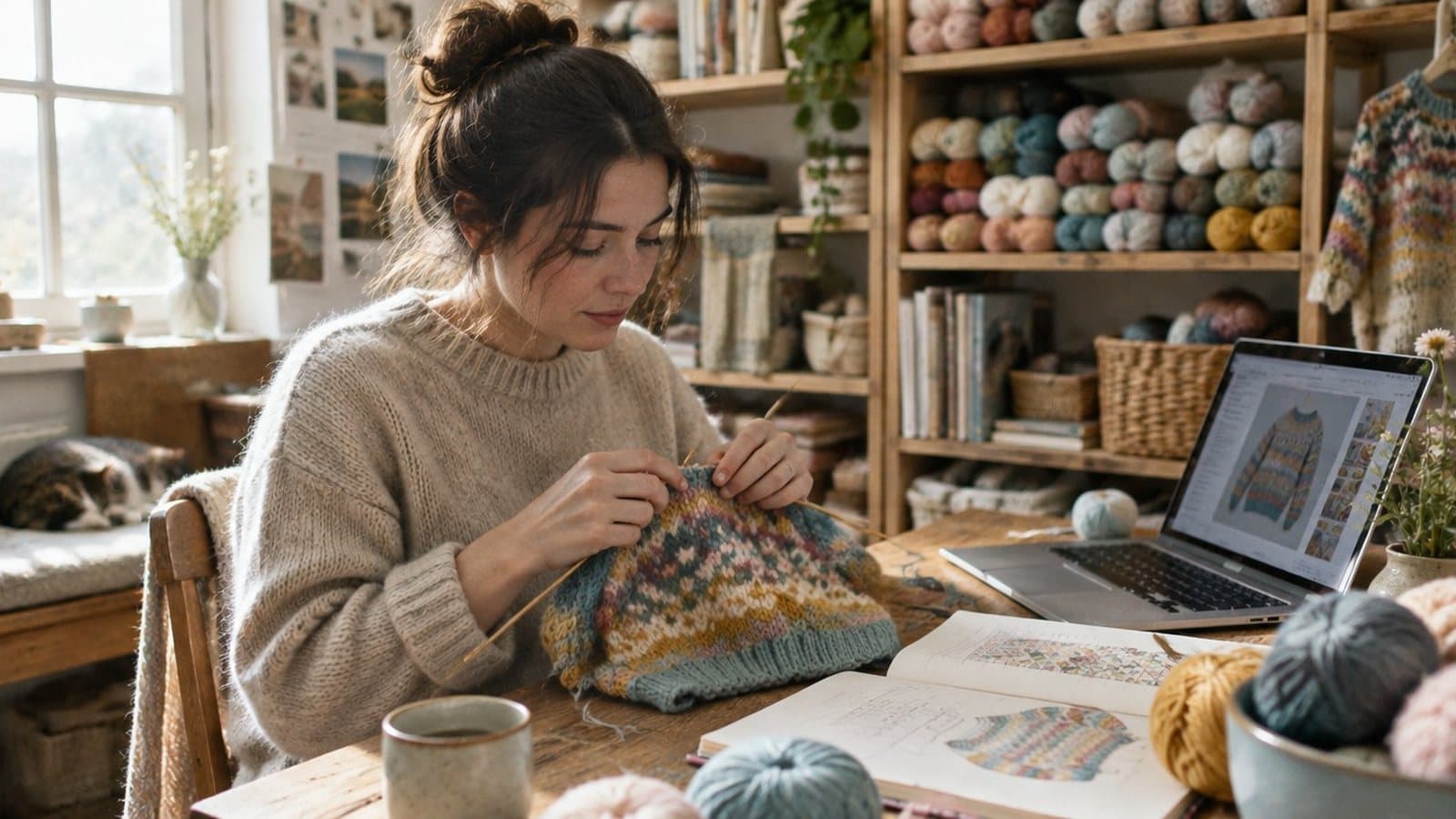
A bio-link for knitting pattern designers bundles your Ravelry profile, Etsy shop, direct PDF sales and workshop sign-ups on one mobile-optimised page — so Instagram and Pinterest traffic converts directly to sales and email subscribers. Scroll to the 5-step checklist to get started today.
⚡ One link, all your knitting sold. Jump to the 5-step checklist, or try LinkDash free.
Definitions: bio-link terms for craft designers
- Bio-link page
- In one sentence: A mobile-optimised landing page behind your social media "link in bio" where you bundle multiple destinations — from Ravelry to direct checkout.
- Mini Shop / Embedded checkout
- In one sentence: A built-in shopping experience on your bio-link where buyers purchase PDF patterns directly without external redirects, including European payment methods like iDEAL, Wero and card payments.
- KAL (Knit-Along)
- In one sentence: An organised knitting event where participants work on the same pattern simultaneously, often featuring live sessions, community interaction and exclusive content.
- Yarn affiliate link
- In one sentence: A trackable link to a yarn shop where you receive commission when someone purchases through your link — typically 5-15% of order value.
- Seasonal link block
- In one sentence: A temporarily visible section on your bio-link that you activate for specific periods like Christmas patterns or autumn collections.
Why do knitting pattern designers need a bio-link?
Short answer: Because your sales are scattered across Ravelry, Etsy, your own website and affiliate programmes — and Instagram only allows one clickable link.
As a knitting pattern designer, you have a fragmentation problem. Your latest scarf pattern is on Ravelry. You sell yarn kits through Etsy. Your KAL sign-ups run through a Google Form. And your yarn partner expects you to promote their affiliate link. Meanwhile, your Instagram bio reads: "Link in bio for more info."
That single link has to point somewhere. And "somewhere" is usually your Etsy homepage — meaning 80% of your visitors never see your Ravelry patterns, your workshop, or your newsletter sign-up.
A bio-link solves this by bundling everything into a visually appealing, mobile-optimised page. Visitors immediately see:
- Your newest patterns (with direct checkout)
- Link to your complete Ravelry portfolio
- Upcoming workshops and KAL dates
- Seasonal collections (Christmas patterns, for instance)
- Email sign-up for new releases
The difference? Instead of choosing one destination, you let the visitor choose — and convert more of your Instagram and Pinterest traffic into actual sales.
How do you integrate Ravelry and Etsy into one bio-link page?
Short answer: Add both platforms as visual link blocks with product images, and use your bio-link's Mini Shop for direct PDF sales without platform commission.
Most knitting pattern designers sell through multiple channels. Ravelry is home base for the international knitting community — with over 9 million registered members according to the platform. Etsy attracts buyers searching for "knitting kits" or "crochet patterns". And increasingly, designers sell directly through their own checkout to avoid the 12-15% platform commission.
The three-layer sales structure
An effective bio-link for knitting pattern designers uses three layers:
| Layer | Purpose | Implementation | Commission |
|---|---|---|---|
| Direct sales | PDF patterns without intermediary | Mini Shop with European payments | 0% (payment processing only) |
| Ravelry integration | Show complete portfolio | Link block to designer page | 0% (free platform) |
| Etsy referral | Yarn kits and physical products | Product links with images | 6.5% + transaction fees |
| Affiliate links | Promote recommended yarns | Partner link blocks | Negative (you earn 5-15%) |
| Workshop sales | Live and on-demand lessons | Calendly embed or form | Depends on platform |
| Email capture | Future launch sales | Integrated sign-up form | 0% |
The art is placing direct sales prominently (highest margin) whilst keeping Ravelry and Etsy accessible for buyers who prefer those platforms.
How do you sell PDF patterns directly via your bio-link with European payments?
Short answer: With a Mini Shop feature, you upload PDFs, set a price, and European buyers check out directly with card payments, Apple Pay, Google Pay or local methods — no redirect to external platforms required.
This is where the real margin sits. On Etsy, you pay 6.5% listing and transaction fees plus payment processing. On Ravelry, selling is free, but the platform attracts less UK and European traffic than direct social media referrals.
With direct sales via your bio-link:
- You pay only payment processing (around 1.4% + 20p for UK cards via Stripe)
- You receive the customer's email address for your own list
- You control the entire customer experience
- PDFs deliver automatically after payment
European payment methods that actually convert
Buyers across Europe expect their trusted payment methods. A bio-link with only basic card checkout misses a significant portion of the market:
- Apple Pay / Google Pay — Dominant for mobile purchases in the UK
- iDEAL — Standard in the Netherlands, direct from bank account
- Bancontact — Default in Belgium
- Wero — The new pan-European instant payment standard launching across the continent
- SEPA — For larger amounts or business buyers
A Mini Shop supporting these methods sees conversion rates 40-60% higher than card-only checkouts when selling to European audiences, according to Stripe's 2024 European Payment Methods report.
How do you promote yarn affiliate links and kit bundles effectively?
Short answer: Place affiliate links contextually alongside related patterns, use visual product blocks with yarn imagery, and be transparent about the affiliate relationship.
Yarn affiliate programmes are an underused income stream for pattern designers. You already have your followers' trust — they want to know which yarn you recommend.
Effective affiliate strategies for knitting designers
Pattern-yarn pairing: For each pattern on your bio-link, show the recommended yarn with a direct affiliate link to the shop. "This pattern was designed for [Yarn Name] — order here with 10% discount."
Seasonal bundles: Create an "Autumn Collection" link block featuring both your autumn patterns and affiliate links to matching yarn colours.
Kit collaborations: Some yarn partners offer white-label kits — your pattern + their yarn in one package. Feature these prominently on your bio-link.
Transparency is mandatory. Always disclose that you receive a commission (this is also legally required under UK Consumer Protection from Unfair Trading Regulations and the EU Unfair Commercial Practices Directive). Simple text at the bottom of your affiliate block suffices: "If you purchase through this link, I receive a small commission — thank you for your support!"
How do you manage workshop and KAL sign-ups via your bio-link?
Short answer: Embed a Calendly widget for live sessions or use a sign-up form that feeds directly to your email platform — so participants register in two clicks.
Workshops and Knit-Alongs are the highest-value products for many knitting pattern designers. A KAL combines community, exclusive content and repeat purchases (many participants buy yarn through your affiliate link).
Three sign-up structures that work
Free KAL with email capture: Participants sign up via a form on your bio-link. They join your email list and receive the pattern plus weekly instructions. Revenue model: yarn affiliate sales and upsell to premium version.
Paid workshop with direct checkout: Use your Mini Shop for workshop access. After payment, participants automatically receive the Zoom link or course platform access.
Live session bookings: Embed a Calendly widget for 1-on-1 knitting lessons or small group sessions. Participants choose a time slot and pay directly.
The advantage of sign-ups via your bio-link (versus an external registration page): you keep visitors in your ecosystem and can cross-sell to other products on the same page.
Bio-link configurations by craft designer type
The Ravelry-first designer
You have 50+ patterns on Ravelry and a loyal international fanbase. Your bio-link focuses on:
- Hero link to your Ravelry designer page
- "New this month" section with 2-3 recent releases (direct PDF sales)
- Email sign-up for pattern release notifications
- Affiliate links to recommended yarn brands
Primary KPI: Collecting email addresses for direct launch sales (less dependent on Ravelry's algorithm).
The Etsy yarn kit seller
You sell physical kits: yarn + pattern + notions in one package. Your bio-link emphasises:
- Visual product grid with kit photos (linking to Etsy listings)
- "Custom kit request" form for special colour requests
- Seasonal collections (Christmas kits, baby kits)
- Behind-the-scenes link to Instagram Stories Highlights
Primary KPI: Etsy click-throughs and custom requests.
The workshop instructor
You teach online knitting classes and organise KALs. Your bio-link revolves around:
- Calendly embed for bookings
- Upcoming KAL sign-up with countdown timer
- Free mini-pattern as lead magnet (email capture)
- Testimonials from previous participants
Primary KPI: Workshop bookings and KAL registrations.
The YouTube/Pinterest creator
You're building an audience through video tutorials and pins. Your bio-link must convert traffic:
- "Pattern from this video" direct links for recent content
- Newsletter sign-up with free pattern incentive
- Affiliate links to tools and yarns from tutorials
- Patreon/Ko-fi link for supporters
Primary KPI: Email addresses and affiliate conversions.
The multi-platform professional
You combine everything: Ravelry, Etsy, own webshop, Patreon, workshops. Your bio-link is your command centre:
- Intelligent categorisation: Patterns | Kits | Learn | Community
- Featured product rotation (automatic or manual)
- Seasonal blocks for campaigns
- Analytics per link block to see what converts
Primary KPI: Revenue per bio-link visitor.
How do you convert Instagram and Pinterest traffic to your email list?
Short answer: Offer a free pattern or exclusive discount in exchange for an email address, placed prominently on your bio-link with a clear value proposition.
Social media platforms are borrowed ground. Instagram could halve your reach tomorrow (it's happened before). Pinterest algorithms change. But an email list is yours.
Lead magnets that work for knitting designers
Free mini-pattern: A simple dishcloth, beanie or cable stitch sample. Low barrier, immediately valuable.
Discount on first purchase: "15% off your first pattern" works well for Etsy/direct sales.
Exclusive preview: "Receive new patterns 48 hours before Instagram." Plays on FOMO without giving anything away free.
Stitch library PDF: A collection of stitch explanations or abbreviation chart. Practical and reusable.
Don't place the sign-up form at the bottom of your bio-link. Position it directly below your hero section, with a visually appealing image of the free incentive.
How do you swap seasonal link blocks quickly for Christmas, autumn or summer?
Short answer: Use a bio-link platform with scheduling or quick-toggle functionality to activate pre-prepared seasonal blocks without manually removing links.
Knitting pattern sales are extremely seasonal. Christmas patterns sell from September to December. Summer tops in March-April. Back-to-school accessories in August.
A smart bio-link setup:
Prepare in advance: Create four seasonal blocks (spring, summer, autumn, winter) with relevant patterns and affiliate links.
Use scheduling: Platforms with scheduling let you auto-activate blocks on specific dates. Christmas block goes live on 1 September, disappears on 26 December.
Pinned vs. rotating: Keep your top 3 evergreen links permanently at the top. Seasonal blocks appear below and disappear after the period.
Analytics per season: Track which seasonal patterns convert best. Next year you'll know exactly which products to feature.
5-step checklist: setting up your bio-link as a knitting pattern designer
- Audit your current sales and platforms — List all the places you sell (Ravelry, Etsy, own site, affiliate programmes) and prioritise by margin and volume.
- Configure your Mini Shop for direct PDF sales — Upload your 3-5 best-selling patterns with card and Apple Pay checkout. Test the buyer experience yourself.
- Build your link structure — Categorise: Patterns (direct) | Ravelry | Etsy | Workshops | Affiliate. Place highest-margin items at the top.
- Integrate email capture — Connect your bio-link form to Mailchimp, ConvertKit or your email platform. Create your lead magnet incentive.
- Plan seasonal blocks — Set up at minimum your Christmas and spring collections with scheduling or quick-toggle.
⚡ Still selling your patterns via six different links?
LinkDash bundles your Ravelry, Etsy, direct PDF sales and workshops on one page — with European payment checkout built in.
Try LinkDash free → no credit card · 5 minute setup
Edge cases and grey areas
I only sell on Ravelry — do I need a bio-link?
If 100% of your sales go through Ravelry and you're not converting Instagram/Pinterest traffic, the added value is smaller. But: a bio-link with email capture means you're not fully dependent on Ravelry's platform for pattern launch communications. Once your list grows, you can add direct sales with higher margins.
My patterns are free — why would I use a bio-link?
Free patterns are a lead generation strategy. Your bio-link bundles email sign-up (for future paid releases), affiliate links to recommended yarns, and optional donation links (Ko-fi, Buy Me a Coffee). Even without direct pattern sales, you monetise your audience.
How do I prevent my bio-link becoming too cluttered with all platforms?
Categorise visually. Use headers like "Shop my patterns" and "Learn to knit with me". Limit yourself to 8-12 visible links maximum. Hide less important links in a collapsible section or footer.
Should I link my Etsy shop URL or individual listings?
Both. Link your shop homepage as a general destination, but feature 2-3 individual bestseller listings with product images. Specific product links convert better than homepage links.
How do I track which bio-link blocks convert best?
Use a bio-link platform with built-in analytics per link block. You want to know: which links get the most clicks? Which lead to actual sales? This data informs your link structure prioritisation.
Note: the effectiveness of specific strategies varies by audience and platform algorithms. Test configurations and analyse your own data for optimal results.
Disclaimer and sources
This article is written for informational purposes and does not constitute financial or legal advice. Platform terms, commission structures and affiliate percentages may change. Always check current terms of mentioned platforms.
Sources consulted:
- Ravelry Designer Resources — ravelry.com
- Etsy Seller Handbook: Fees and Payments — etsy.com/uk/seller-handbook
- Mailchimp E-commerce Email Marketing Guide — mailchimp.com
- Stripe European Payment Methods Report 2024 — stripe.com
- UK Advertising Standards Authority: Affiliate Disclosure Guidelines — asa.org.uk
Frequently asked questions
What is a bio-link page?
A bio-link page is a mobile-optimised landing page behind your social media "link in bio" where you bundle multiple destinations — from Ravelry to direct checkout.
What is a Mini Shop or embedded checkout?
A Mini Shop or embedded checkout is a built-in shopping experience on your bio-link where buyers purchase PDF patterns directly without external redirects, including European payment methods like iDEAL and Wero.
What is a KAL (Knit-Along)?
A KAL (Knit-Along) is an organised knitting event where participants work on the same pattern simultaneously, often featuring live sessions, community interaction and exclusive content.
What is a yarn affiliate link?
A yarn affiliate link is a trackable link to a yarn shop where you receive commission when someone purchases through your link — typically 5-15% of order value.
What is a seasonal link block?
A seasonal link block is a temporarily visible section on your bio-link that you activate for specific periods like Christmas patterns or autumn collections.
Why do knitting pattern designers need a bio-link?
Knitting pattern designers need a bio-link because their sales are scattered across Ravelry, Etsy, own websites and affiliate programmes — whilst Instagram only allows one clickable link. A bio-link bundles everything on one page.
How do I integrate Ravelry and Etsy into one bio-link page?
You integrate Ravelry and Etsy by adding both platforms as visual link blocks with product images. Use your bio-link's Mini Shop for direct PDF sales without platform commission, whilst keeping Ravelry and Etsy accessible for buyers who prefer those platforms.
Which European payment methods should my bio-link support?
For European buyers, your bio-link should support at minimum card payments, Apple Pay, Google Pay, and ideally iDEAL (for Dutch customers), Bancontact (Belgium) and Wero (the new pan-European standard). This can increase conversion rates 40-60% compared to card-only checkouts.
How do I convert Instagram traffic to my email list?
Offer a free pattern or exclusive discount in exchange for an email address, prominently placed on your bio-link. Effective lead magnets include free mini-patterns, discount on first purchase, exclusive previews, or a stitch library PDF.
How do I swap seasonal link blocks quickly?
Use a bio-link platform with scheduling or quick-toggle functionality. Prepare seasonal blocks in advance (spring, summer, autumn, winter) and activate them automatically on specific dates, or toggle them on/off manually without deleting links.
Do I need to disclose affiliate relationships on my bio-link?
Yes, transparency about affiliate relationships is legally required under UK Consumer Protection Regulations and EU Unfair Commercial Practices Directive. Always disclose that you receive commission when someone purchases through your link. Simple text at the bottom of your affiliate block suffices.
How do I prevent my bio-link becoming too cluttered?
Categorise visually with headers like "Shop my patterns" and "Learn to knit with me". Limit yourself to 8-12 visible links maximum and hide less important links in a collapsible section or footer.
Next steps
Ready to streamline your knitting pattern business? Start free with LinkDash and bundle your Ravelry, Etsy and direct sales on one page. Or read more about selling digital products via your bio-link and email capture strategies for creators.