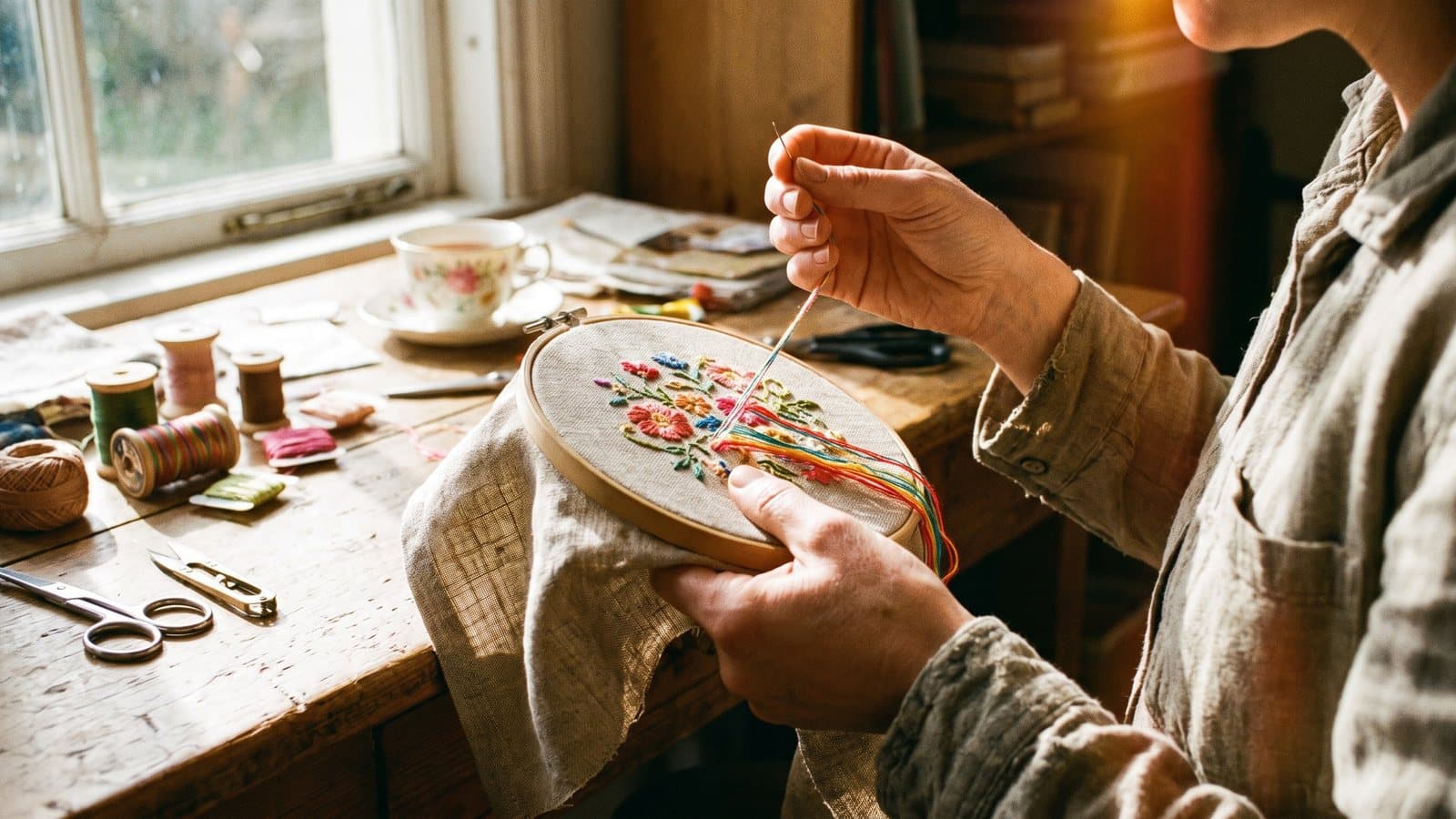
An embroidery artist needs more than a simple link collection: you're selling digital PDF patterns, physical embroidery kits, and workshop spots — while your detailed needlework must remain centre stage. A well-structured bio-link solves this by bringing portfolio, shop and bookings together on one page that converts directly from Instagram and TikTok. Scroll to the 5-step checklist to get started immediately.
⚡ From embroidery reel to sale in three clicks. Jump to the 5-step checklist, or try LinkDash free.
Core terms for embroidery artists
- Bio-link
- In one sentence: The clickable URL in your Instagram or TikTok profile that sends visitors to a landing page with all your links, products and bookings.
- Mini Shop
- In one sentence: A built-in webshop on your bio-link where you sell up to several dozen products without needing an external e-commerce platform.
- Digital pattern (PDF)
- In one sentence: A downloadable file with embroidery instructions, stitch diagrams and colour codes that buyers receive immediately after payment.
- Physical embroidery kit
- In one sentence: A package containing fabric, thread, needle and printed instructions that you ship by post.
- Workshop booking
- In one sentence: A reserved spot for an online Zoom session or in-person class, typically with advance payment.
- Wero
- In one sentence: The new pan-European payment system from the European Payments Initiative enabling direct account-to-account transactions across the Netherlands, Belgium, Germany and France.
- iDEAL
- In one sentence: The dominant Dutch online payment method where buyers pay directly via their own bank — used in over 90% of Dutch e-commerce transactions.
- QR-code attribution
- In one sentence: A scannable code on your work or packaging that links to your bio-link, so anyone who sees your embroidery can find your page instantly.
Why do embroidery artists need a specialised bio-link?
Short answer: Because you're selling three different product types (digital, physical, services) that each require distinct checkout flows, while your portfolio must visually convince with macro-level detail.
Embroidery is unique within the creative niche world. Your Instagram feed showcases close-ups of satin stitch on linen, time-lapse videos of a floral motif emerging, and the finished result framed on a wall. But when a follower wants to buy, the journey stalls: "Link in bio" leads to a page with seven random links where nobody knows what to click.
The European embroidery market continues to grow steadily. Platforms like Etsy report that "embroidery patterns" rank among the fastest-growing digital product categories, particularly among buyers aged 25-45 who combine craft hobbies with digital convenience. According to Etsy's 2023 seller report, needlework patterns saw a 47% increase in searches year-over-year. Meanwhile, local buyers in the UK, EU and beyond increasingly seek payment methods they trust — whether that's Open Banking in Britain, iDEAL for Dutch customers, or Wero as the emerging pan-European option.
A generic link-in-bio tool doesn't solve this. You need a platform that:
- Supports high-resolution galleries for macro photography
- Automatically delivers digital downloads after payment
- Handles physical products with shipping options
- Manages workshop bookings with date selection and payment confirmation
- Natively integrates European payment methods
How do you set up a portfolio gallery for embroidery macro photography?
Short answer: Use a gallery block with square or 4:5 thumbnails, but link through to full-resolution detail shots that reveal the stitch structure.
Embroidery sells through detail. A follower watching your reel wants to see the texture of the thread, the shadow of a French knot, the tension of the fabric in the hoop. Your bio-link portfolio must support this level of detail without destroying load times.
Technical settings for optimal display
Export your photos as WebP with a minimum width of 1600 pixels for full-size viewing. Thumbnails can be 600x600 pixels. Avoid JPEG compression below 85% — embroidery details lose sharpness at higher compression. Use a subtle vignette to guide the eye to the centre, but avoid filters that distort thread colours.
Gallery structure that converts
Group your work thematically rather than chronologically:
- Botanical embroidery — flowers, leaves, succulents
- Portrait embroidery — faces, pets, wedding portraits
- Typography — quotes, names, birth announcements
- Abstract — texture experiments, mixed media
Each category gets its own gallery block with 4-8 pieces. Below each gallery, place a direct link to related patterns or a "Request a commission" button.
Digital PDF patterns versus physical kits: what do you sell and how?
Short answer: Digital patterns deliver higher margins and passive income; physical kits justify premium prices and build loyalty, but require inventory management and shipping logistics.
| Aspect | Digital PDF pattern | Physical embroidery kit |
|---|---|---|
| Production costs | One-time (design + PDF layout) | Per unit (materials + packaging) |
| Typical selling price (UK/EU) | £4 – £12 / €5 – €15 | £20 – £55 / €25 – €65 |
| Profit margin | 85-95% (after transaction fees) | 40-60% (depending on material sourcing) |
| Delivery | Automatic, instant after payment | Manual shipping, 2-5 working days |
| Inventory management | Not required | Crucial — thread, fabric, needles |
| Scalability | Unlimited | Limited by production time |
| Customer experience | Practical, instant access | Unboxing moment, premium feel |
| Suitable for beginners? | Moderate — requires own material sourcing | Excellent — everything included |
Mini Shop configuration for digital patterns
In your LinkDash Mini Shop, upload the PDF pattern as a digital product. Enable automatic delivery: the buyer receives a download link by email and on the thank-you screen immediately after payment. Add a preview image showing a portion of the pattern — enough to demonstrate the style, not enough to recreate.
Mini Shop configuration for physical kits
Physical products require shipping options. Configure UK shipping (Royal Mail large letter, £2.50), EU shipping (tracked, €6-8) and international options as needed. Consider a free shipping threshold at £40/€50+ to encourage bundling. Set inventory per kit and activate "sold out" notifications so you can restock in time.
How do you integrate workshop bookings — online and in-person?
Short answer: Treat online Zoom workshops and local sessions as separate products with their own date slots, maximum participant numbers and clear logistical instructions.
Workshops often represent the highest revenue per hour for embroidery artists. A 2-hour Zoom session with 15 participants at £30 each generates £450. An in-person workshop in your studio with 8 participants at £45 (including materials) brings in £360 — plus the opportunity to upsell kits and materials on the spot.
Online workshop configuration
- Product type: Service/booking
- Date/time: Specific slot (e.g. "Saturday 15 March, 2:00-4:00 PM GMT")
- Maximum participants: 12-20 for interactive sessions, higher for demonstrations
- Price: £20-£45 depending on duration and level
- After purchase: Automatic email with Zoom link, materials list, and preparation notes
In-person workshop configuration
- Location: Include address, parking options, public transport access
- Maximum participants: 6-10 for hands-on guidance
- Price: £35-£65 including materials
- After purchase: Confirmation email with directions and what to bring
Create a separate product block in your Mini Shop for each workshop type. Group them under a "Workshops" section on your bio-link with clear separation between online and in-person offerings.
QR codes on finished work and packaging: how does artist attribution work?
Short answer: A QR code linking to your bio-link ensures anyone who sees your work — at the buyer's home, at a market, or via a photo — can find your page instantly and make a purchase.
Embroidery travels. It hangs on walls, gets photographed, shared on Pinterest, given as gifts. Without attribution, the artist disappears from the story. A QR code solves this.
Where do you place QR codes?
- Back of framed work: Sticker with QR, your name, and "More work: [linkdash.io/yourlink]"
- Certificate of authenticity: For commission pieces and premium work
- Kit packaging: On the outside and inside with the instructions
- Business card in shipments: Small card with QR and social handles
- Labels on loose materials: If you sell hand-dyed thread or fabric
Generating and styling QR codes
Generate your QR code with your full bio-link URL. Choose a format with error correction (Level M or higher) so the code remains scannable if partially covered. Style the code in your brand colours, but maintain sufficient contrast. Test on at least three smartphones before printing.
Adding tracking
Add UTM parameters to your QR URL to measure which placement generates the most traffic:
?utm_source=qr&utm_medium=packaging&utm_campaign=kit-launch?utm_source=qr&utm_medium=artwork-back&utm_campaign=commissions
From hashtags to bio-link: how do you build a conversion funnel on Instagram and TikTok?
Short answer: Use niche-specific hashtags to get discovered, reference your bio-link in content, and optimise that link for the action you want (buy, book, follow).
Effective hashtags for embroidery artists
The balance lies between reach and relevance. Mega-hashtags (#embroidery, 15M+ posts) give brief visibility; niche tags (#botanicalembroidery, #floralthreadpainting) attract more interested audiences.
UK/International market:
- #embroideryart #embroiderypattern #modernembroidery
- #needlework #embroideryinstaguild #slowstitching
- #handembroidery #contemporaryembroidery #stitchersofinstagram
For broader European reach:
- #broderie (French) #borduren (Dutch) #sticken (German)
- #handmadeeurope #europeanmakers #crafteurope
Content-to-link strategy
- Hook: Reel shows the finished piece in 3 seconds
- Process: 10-30 seconds time-lapse or slow-mo of stitching
- CTA: "Pattern available — link in bio" (spoken and text overlay)
- Bio-link: Direct link to the specific pattern at the top
How do European payment methods work for international embroidery sales?
Short answer: European buyers prefer local payment methods — iDEAL in the Netherlands (90%+ of online payments), Bancontact in Belgium, and increasingly Wero as the pan-European option that bypasses card networks entirely.
iDEAL: the Dutch standard
Dutch buyers expect iDEAL. It's the payment method for over 90% of online transactions in the Netherlands. Integration via Stripe (which LinkDash uses) activates iDEAL automatically for Dutch IP addresses. The buyer selects their bank, logs in via their bank app, and confirms. Funds arrive in your account immediately.
Wero: the pan-European future
Wero, launched by the European Payments Initiative, operates across the Netherlands, Belgium, Germany and France. The system bypasses Visa/Mastercard and sends money directly from bank account to bank account. For embroidery artists with international audiences, this lowers transaction costs and increases conversion among German, Belgian and French buyers who don't want to use credit cards.
UK Open Banking and card payments
For UK buyers, Open Banking enables similar bank-to-bank transfers, though card payments remain dominant. Credit and debit cards via Stripe handle worldwide customers, making your bio-link accessible to buyers from the US, Canada, Australia and beyond.
Checkout configuration in LinkDash
In your LinkDash Mini Shop, you activate payment methods via settings. iDEAL appears automatically for Dutch visitors. Wero shows as an option when available in the buyer's browser/region. Credit and debit cards work globally. You don't need separate accounts — everything runs through one Stripe integration.
| Payment method | Region | Transaction fees (indicative) | Payout |
|---|---|---|---|
| iDEAL | Netherlands | €0.29 flat | 1-2 working days |
| Bancontact | Belgium | 1.4% + €0.25 | 1-2 working days |
| Wero | NL, BE, DE, FR | Not yet finalised | Instant |
| UK cards (Stripe) | United Kingdom | 1.4% + 20p (domestic) | 2 working days |
| Credit card | Worldwide | 1.4-2.9% + £0.20/€0.25 | 2 working days |
5-step checklist: launching your embroidery bio-link
- Structure your portfolio: Categorise your work thematically (botanical, portrait, typography). Upload 4-8 high-resolution images per category with macro details.
- Set up your Mini Shop: Add 3-5 digital patterns as downloadable products. Add at least 1 physical kit with shipping options for UK, EU and international.
- Add workshop bookings: Create separate products for online (Zoom) and in-person sessions. Set date slots and maximum participants.
- Activate payment methods: Connect your Stripe account and enable iDEAL, Bancontact, cards and Wero (where available).
- Generate QR codes: Create tracking URLs for packaging and artwork. Print test codes and verify scannability on multiple devices.
⚡ Ready to sell your embroidery without Etsy commissions?
LinkDash combines portfolio, shop and bookings on one page with European payment methods — built for makers who sell internationally.
Try LinkDash free → no credit card · 5-minute setup
Scenarios by embroidery artist type
The pattern designer: passive income focus
You design patterns but rarely take commissions. Your bio-link is primarily a digital shop. Structure: large pattern preview block at the top, "Latest patterns" slider, categories below (beginner/advanced), email signup for new releases at the bottom. No portfolio gallery needed — your patterns are your portfolio.
The commission artist: portfolio-first
You create unique pieces to order. Your bio-link must convince, not sell directly. Structure: impactful portfolio gallery at the top, prominent "Request a commission" form link, testimonials from previous clients, price indications by size. Mini Shop contains only gift vouchers or waitlist deposits.
The workshop teacher: bookings central
Your income comes primarily from teaching. Structure: upcoming workshop at the top with countdown timer, calendar with all upcoming dates, testimonials from participants, free trial lesson video or mini-tutorial as lead magnet. Patterns and kits are secondary — support material for students.
The hybrid maker: everything sells
You take commissions, sell patterns, teach workshops, and have a physical kit line. Structure: rotating hero section with seasonal offerings, clear category navigation ("Shop" / "Learn" / "Commission"), smart links that lead to the most relevant content. Your bio-link effectively becomes a mini-website.
The market seller: offline to online
You sell at craft fairs and want to convert physical visitors into online followers and buyers. QR codes on your stand banner, business cards and packaging are essential. Your bio-link opens with a "Lovely to meet you!" message, email capture for market discount, and links to your socials. The shop comes second — the goal is continuing the relationship after the market.
Edge cases and common mistakes
"Should I keep selling on Etsy alongside my bio-link?"
Etsy has discovery value: people actively search for embroidery patterns. But Etsy's commissions (6.5% + payment processing fees) and their algorithm promoting competitors make it unsuitable as a primary channel. Use Etsy as a discovery funnel: sell there, but add a QR code or business card to every shipment leading to your bio-link. Regular customers then buy directly from you.
"Can I protect my PDF patterns from resale?"
Technically, barely. Watermarks help for identification after the fact, but won't stop a determined pirate. Pragmatic approach: add your contact details and bio-link to every page of the PDF, build a community around your patterns (Facebook group, Discord) where buyers can ask questions, and make your free content so valuable that people want to support you. Your ongoing value — tips, variations, Q&A — cannot be copied.
"How do I price my work without underselling myself?"
Calculate your hourly rate backwards. If a pattern takes 20 hours to design and you want at least £20/hour, £400 is your break-even. Divide by expected first-year sales (e.g. 100) = £4 minimum price. Add value for higher prices: video instructions, colour variations, community access.
"Do I need insurance for in-person workshops?"
Yes. Public liability insurance for creative workshops costs £50-150/year and protects you if someone trips in your studio or has an allergic reaction to materials. In the UK, check that your home insurance covers business use of your space, or take out separate craft business insurance.
"How do I handle multiple languages on my bio-link?"
If your audience is mixed (UK followers + European international), choose English as your primary language for product names and buttons. Add local language descriptions where relevant for specific markets. Your portfolio speaks for itself — strong visuals transcend language barriers.
Every situation is unique. This article provides general guidance — consult an accountant for tax questions and a solicitor for contractual matters around commissions and intellectual property.
Disclaimer and sources
This article is intended for information only and does not constitute legal or financial advice. Prices, commission percentages and platform features may change. Always verify the latest terms with the services mentioned.
Sources:
- European Payments Initiative (EPI) — wero.eu
- Stripe UK: Payment methods documentation — stripe.com/gb/payments
- Royal Mail: Business shipping rates — royalmail.com/business
- HMRC: VAT for digital services — gov.uk/guidance/vat-on-digital-services
- Etsy: Seller fees and payments — etsy.com/uk/legal/fees
Frequently asked questions
What is a bio-link for embroidery artists?
A bio-link for embroidery artists is the clickable URL in your Instagram or TikTok profile that sends visitors to a landing page with all your links, portfolio, products and workshop bookings — specifically designed to showcase your needlework and convert followers into buyers.
What is the difference between a digital pattern and a physical embroidery kit?
A digital pattern is a downloadable PDF file with embroidery instructions that buyers receive immediately after payment. A physical embroidery kit contains fabric, thread, needle and printed instructions that you ship by post. Digital patterns have higher margins; kits justify premium prices.
What is Wero and why is it relevant for embroidery artists?
Wero is the new pan-European payment system enabling direct account-to-account transactions across the Netherlands, Belgium, Germany and France. For embroidery artists with international audiences, this lowers transaction costs and increases conversion among buyers who don't want to use credit cards.
How does iDEAL work for embroidery sales?
iDEAL is the Dutch online payment standard where buyers pay directly via their own bank. When integrated via platforms like Stripe, iDEAL appears automatically for Dutch visitors. The buyer selects their bank, confirms in the bank app, and funds arrive in your account immediately.
How do I set up a portfolio gallery for macro photography of embroidery?
Use a gallery block with square or 4:5 thumbnails that link through to full-resolution detail photos. Export images as WebP with a minimum width of 1600 pixels. Group thematically (botanical, portrait, typography) rather than chronologically, and place direct links to related patterns below each gallery.
Can I sell both online Zoom workshops and in-person sessions via my bio-link?
Yes, treat them as separate products with their own date slots, maximum participant numbers and specific instructions. Online workshops receive automatic Zoom link delivery; in-person workshops receive location details and directions in the confirmation email.
How do I use QR codes for artist attribution on my embroidery work?
Generate QR codes linking to your bio-link and place them on the back of framed work, certificates of authenticity, packaging, and business cards. Add UTM parameters to measure which placement generates the most traffic.
Which hashtags should I use to promote my embroidery?
Combine broad tags (#embroidery, #needlework) for reach with niche tags (#botanicalembroidery, #slowstitching) for more relevant audiences. Platform-specific tags like #embroideryinstaguild and #stitchersofinstagram work well for community building.
What are the transaction fees for embroidery sales?
iDEAL costs approximately €0.29 flat per transaction. UK cards cost 1.4% plus 20p domestically. Credit cards cost 1.4-2.9% plus £0.20/€0.25. Bancontact (Belgium) costs 1.4% plus €0.25. Wero costs are not yet finalised but expected to be competitive.
Should I keep selling on Etsy alongside my bio-link?
Etsy has discovery value but takes 6.5% commission plus payment processing fees and promotes competitors. Use Etsy as a discovery funnel: sell there, but add a QR code or business card to every shipment directing customers to your bio-link for future direct purchases.
How do I protect my PDF patterns from resale?
Technical protection has limited effectiveness. More pragmatic: add your contact details and bio-link to every PDF page, build a community where buyers can ask questions, and make your free content so valuable that people want to support you. Your ongoing support cannot be copied.
How do I handle multiple languages on my bio-link?
If your audience is mixed, choose English as your primary language for product names and buttons. Add local language descriptions where relevant for specific markets. Your portfolio speaks visually for itself — strong imagery transcends language barriers.
Start your embroidery bio-link today
Your embroidery deserves more than a row of scattered links. With a well-structured bio-link, every Instagram reel, TikTok video and craft fair encounter becomes an opportunity to sell — without commissions to platforms that don't understand your craft.
Read more: