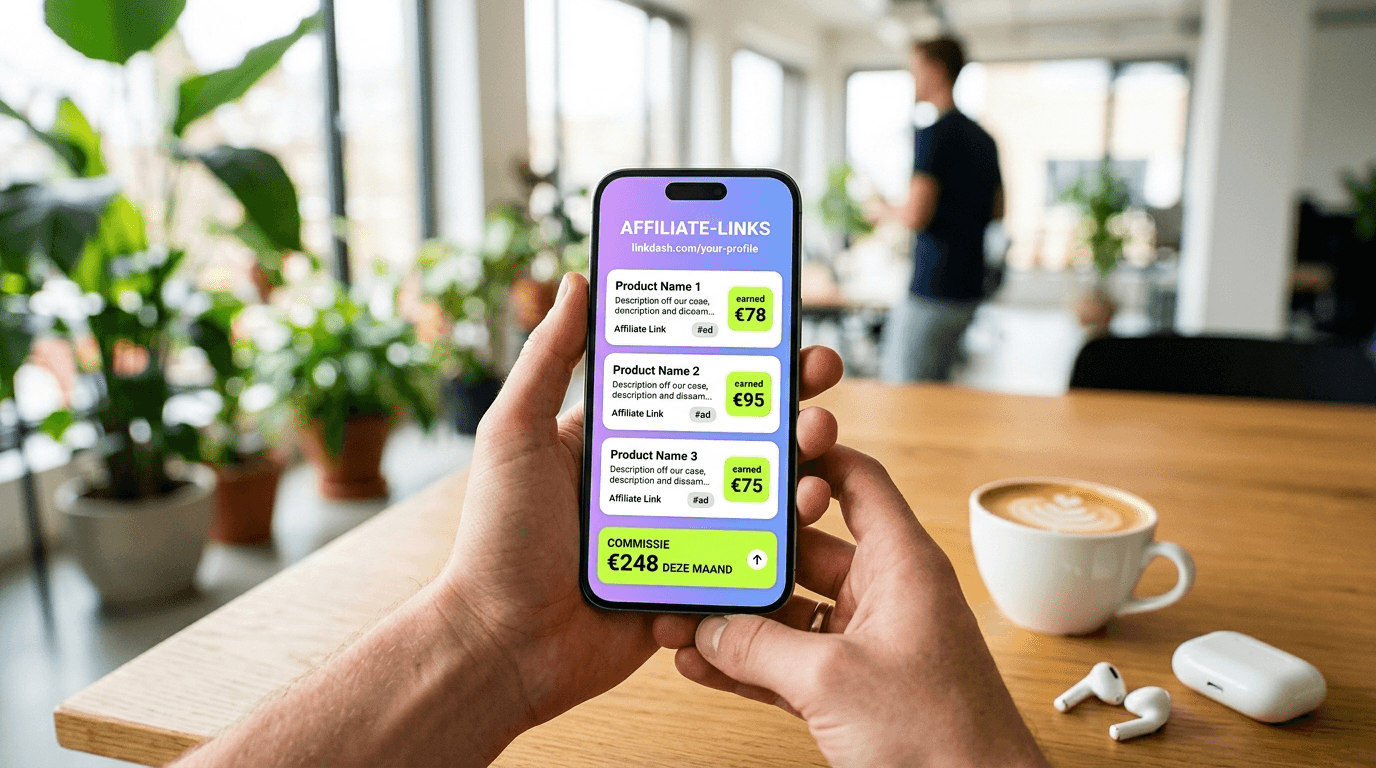
Yes, you can place affiliate links in your bio page and earn decent income from them — provided you're transparent about the commercial relationship and don't mislead your audience with hidden interests. Consumer protection authorities like the ASA (UK) and FTC (US) require you to clearly indicate when you receive commission, but this doesn't have to kill your conversion rate. In this guide, you'll learn exactly how to apply disclosure correctly, which programmes suit your niche, and which placement patterns actually convert. Jump to the 5-step checklist for the quick version.
⚡ Affiliate income without breaking trust. Jump to the 5-step checklist, or try LinkDash free.
Core concepts: affiliate marketing for bio pages
- Affiliate link
- In one sentence: A URL containing your unique tracking code that allows an advertiser to attribute a purchase or sign-up to you, so you receive commission.
- Disclosure
- In one sentence: The legally required notice that you have a commercial interest in the link — enforced in the UK by the ASA and CMA under consumer protection regulations, and in the EU under the Unfair Commercial Practices Directive.
- Cookie window
- In one sentence: The period (typically 24 hours to 30 days) during which a purchase is still attributed to your affiliate link after someone clicks.
- Link cloaking
- In one sentence: Masking a long affiliate URL behind a short, custom domain (e.g., yourdomain.com/go/product) — legally permitted as long as disclosure is present.
- EPC (Earnings Per Click)
- In one sentence: The average commission you earn per 100 or 1,000 clicks on an affiliate link — the key metric for comparing programmes.
- Bio page / link-in-bio
- In one sentence: A landing page (often on a tool like LinkDash) that you link in your social profiles, bundling multiple destinations — including affiliate links.
What are the disclosure rules for affiliate links in the UK and EU?
Short answer: You must make it clear before the click that you receive commission. A small asterisk at the bottom of the page isn't sufficient — regulators expect the notice to be "clear and prominent" next to the link itself.
The legal basis varies by jurisdiction but shares common principles:
- UK: The ASA (Advertising Standards Authority) and CMA (Competition and Markets Authority) enforce the Consumer Protection from Unfair Trading Regulations 2008. Their guidance explicitly states that affiliate relationships must be disclosed "upfront" and not buried in small print.
- EU: The Unfair Commercial Practices Directive (2005/29/EC) prohibits "concealing the commercial intent of a commercial practice." Member states enforce this through national regulators.
- The Digital Services Act (DSA), fully in force since February 2024, strengthens these rules by making platforms co-responsible for unlabelled commercial content.
- For US-based audiences, the FTC requires disclosures that are "clear and conspicuous" — similar principles, different enforcement body.
What does correct disclosure look like?
You have two options that hold up legally:
- Label in the link title itself — add "(affiliate)" or "(ad)" to the button text: "My favourite camera (affiliate link)".
- Inline disclaimer directly above the affiliate section — a short sentence like: "If you buy through the links below, I may earn a small commission at no extra cost to you."
Option 1 is safest because the disclosure is literally attached to the link. Option 2 works well when you're grouping multiple affiliate links under one heading.
What you should NOT do
- Only mention "some links are affiliate" in your footer.
- Hide the disclosure in a dropdown menu or "more info" popup.
- Use terms consumers don't understand: "referral" or "ambassador" are too vague.
Which affiliate programmes suit which creator niche?
Short answer: Choose programmes with products you actually use, a reasonable cookie window (≥7 days), and a commission structure that fits the purchase value in your niche — high percentages on cheap products often yield less than lower percentages on expensive items.
| Niche | Recommended programmes | Typical commission | Cookie window | Notes | Best for |
|---|---|---|---|---|---|
| Tech & gadgets | Amazon Associates, Currys, John Lewis Partnership | 1-4% | 24 hours (Amazon) – 30 days (others) | Wide product range, low commission per item | Reviewers, unboxers |
| Fashion & beauty | AWIN network (ASOS, Lookfantastic), ShareASale, Rakuten | 5-12% | 30 days | Seasonal conversion spikes | Style creators, GRWM |
| Software & SaaS | Direct partner programmes (Notion, Canva, ConvertKit, Kajabi) | 20-40% recurring | 30-90 days | Recurring commission on subscriptions | Productivity, business creators |
| Finance & investing | Direct broker programmes (Trading 212, Freetrade, Wise) | £10-50 per sign-up | 30-60 days | CPA model, strict compliance requirements | Finfluencers |
| Courses & education | Skillshare, Udemy, direct creator programmes | 15-50% | 7-30 days | Often free trial structure | Edu-creators, coaches |
| Health & fitness | MyProtein, Bulk, Amazon | 5-15% | 14-30 days | Repeat purchases, lower ticket | Fitness creators, nutrition coaches |
| Travel | Booking.com, GetYourGuide, Viator, Skyscanner | 4-8% | Session-only to 30 days | Booking.com = session-only cookie | Travel bloggers, digital nomads |
| Home & interiors | Wayfair, Made.com (via networks), Amazon | 3-8% | 14-30 days | Higher average order value | Home decor creators |
Network vs direct programme
Networks (AWIN, CJ Affiliate, Rakuten) bundle hundreds of advertisers under one dashboard — convenient for beginners. Direct programmes often offer higher commissions and better support but require separate application and approval per brand.
Rule of thumb: start with 2-3 direct programmes for products you actually use, and supplement with one network for broader coverage.
Link cloaking vs transparency: what's allowed?
Short answer: Link cloaking is legally permitted as long as your disclosure is in order. The problem only arises when you hide the affiliate relationship or suggest the link isn't commercial.
Why creators cloak links
- Readability — a URL like "amazon.co.uk/dp/B09V3KXJPB?tag=yourname-21" is unwieldy in a bio page.
- Branding — "linkdash.com/go/favcamera" looks more professional.
- Flexibility — you can change the underlying URL without updating your social posts.
- Protection — prevents people removing your tag and going directly to the shop.
When cloaking becomes problematic
- When you use the short URL to circumvent disclosure ("it's not an affiliate link, look at the URL").
- When the platform or advertiser explicitly prohibits cloaking — Amazon doesn't allow redirect services that mask the original URL unless you use their SiteStripe or official API.
- When the redirect service itself adds trackers the user doesn't know about.
Best practice
Use your bio page tool (like LinkDash) as the "cloaker" — most tools already generate short, branded URLs. Always add disclosure to the link title or section heading, regardless of how the URL looks.
How do you measure clicks, conversions, and revenue from affiliate links?
Short answer: Combine your affiliate network's analytics with UTM parameters and your bio page statistics to see which links actually generate traffic and conversions — and which only attract clicks without results.
Step 1: Set up UTM structure
Add UTM parameters to your affiliate links before placing them in your bio page. Example structure:
https://www.awin1.com/cread.php?awinmid=1234&awinaffid=5678&ued=https://example.com/product
&utm_source=biopage&utm_medium=affiliate&utm_campaign=summerguide&utm_content=toplink
This way you can see in both your affiliate dashboard and your own analytics exactly which placement converts.
Step 2: Bio page analytics
Every serious bio page tool shows click counts per link. Pay attention to:
- CTR (click-through rate) — percentage of visitors clicking on a specific link.
- Position heatmap — which spot on the page gets the most attention.
- Device split — mobile vs desktop conversion often differs significantly.
Step 3: Connect affiliate dashboard
Most networks (AWIN, CJ Affiliate) offer sub-ID tracking. Enter a unique sub-ID for each link (e.g., "biopage-top" and "biopage-mid") so you can see in the network which bio link generated the conversion.
Step 4: Understand conversion lag
Affiliate commissions often appear 24-72 hours after purchase in your dashboard — and final approval (after the return period) can take 30-60 days. Factor this into your analysis cycle.
Key metrics to check weekly
- Click-to-conversion rate — how many clicks result in a sale? Under 1% = problem with product fit or landing page.
- EPC (Earnings Per Click) — compare programmes; switch to higher EPC where possible.
- Average Order Value (AOV) — with percentage-based commission, higher AOV = higher earnings per conversion.
5 placement patterns that convert (without being pushy)
Short answer: Contextual relevance beats random link dumps. Place affiliate links where they solve a problem your audience already has, not as standalone "shop my favourites" lists without context.
Pattern 1: The "current setup" section
Create a section heading like "My gear" or "What I use" with 3-5 items you actually use daily. Add one sentence of context per item: "My daily camera for 2 years — battery lasts 8 hours (affiliate link)."
Why it works: Visitors actively look for your setup; the affiliate link is a service, not a pushy sales pitch.
Pattern 2: The "from this video" bundle
Link in your bio to a fixed URL you can update per video/post with relevant products. Example: "🎬 Products from my latest video" with 2-3 affiliate links.
Why it works: Context is already provided in your content; visitors expect to find the links.
Pattern 3: The "free alternative + premium" model
Offer a free resource first (your own PDF, Notion template, checklist) and directly below the premium product you're an affiliate for. "📄 My free budget planner" + "📊 YNAB (what I use) — affiliate link".
Why it works: You lead with value; the affiliate link is a logical upgrade option for those who want more.
Pattern 4: The "seasonal highlight" rotation
Rotate your top affiliate link per season or trending topic. In January: "📚 My reading list 2025 (Amazon affiliate)". In November: "🎁 Gift ideas under £50 (affiliate)".
Why it works: Relevance boosts CTR; your audience knows the top link is current.
Pattern 5: The "toolkit" for specific audiences
Create a separate section or even a separate page per persona: "Starter kit for food photography" with 5 affiliate links to camera, lens, ring light, backdrop, editing app.
Why it works: You solve a complete problem; the bundle value exceeds individual links.
Affiliate strategy by creator type
Scenario: Tech reviewer (YouTube/Instagram)
Your audience expects product links. Place your "current setup" prominently at the top, with each item linking to the store where you get the best commission (check if you can join Amazon, Currys, and manufacturer direct programmes to A/B test). Disclosure in section heading: "My gear (affiliate links — you don't pay more)". Rotate your top link to the product from your most recent video.
Scenario: Lifestyle creator (TikTok/Instagram)
Focus on 2-3 categories: beauty, fashion, home. Use the "from this video" pattern with a link you update weekly. Avoid long lists; 5 items is enough. Test fashion networks (AWIN ASOS) against Amazon — fashion-specific networks often have longer cookie windows.
Scenario: Business/productivity creator
This is where the highest commissions lie: SaaS affiliates with recurring revenue. Place your "toolkit" (Notion, Canva, accounting software) with a short use case per tool. Focus on trial conversions; the recurring commission builds passive income. Disclosure is extra important because your audience makes business decisions.
Scenario: Fitness/health creator
Supplements and sportswear are commodities — differentiate with personal experience. "What I take daily" with 3 products and honest nuance ("works for me, check with your GP") converts better than a long list. Choose brands with good reputation; your name is on the line.
Scenario: Niche expert (finance, legal, health-adjacent)
Affiliate programmes in finance have strict compliance requirements. Ensure you never appear to give personal advice. Use phrases like "I personally use broker X (affiliate link) — this is not investment advice." Check the programme's terms; some prohibit certain claims.
5-step checklist: using affiliate links correctly
- Select max 5-7 affiliate links — too much choice lowers CTR. Choose products you know and can recommend without reservation.
- Add disclosure per link or section — "(affiliate)" in the link title or a clear sentence above your affiliate block.
- Structure with context — use section headings like "My setup", "Toolkit", or "From this video" so the link feels logical.
- Set up UTM + sub-ID tracking — know which link converts. Check your EPC weekly and swap underperformers.
- Test placement and rotate seasonally — your top link gets 40-60% of all clicks. Put your best-converting affiliate there.
⚡ Want to add affiliate links to your bio page without the hassle?
LinkDash gives you click analytics per link, easy UTM options, and a clean design where disclosure fits naturally — so you earn without losing your audience.
Try LinkDash free → no credit card · 5-minute setup
Edge cases and grey areas
"Can I use affiliate links if I received the product for free?"
Yes, but then you need double disclosure: both "gifted" or "PR sample" and "affiliate link". The ASA makes no distinction in severity between hidden gifting and hidden affiliate relationships.
"Do I need to add disclosure if I've never actually received commission?"
Yes. It's about the possibility of commission, not whether you've actually earned anything. As soon as you place an active affiliate link, disclosure is required.
"What if my affiliate network doesn't require disclosure?"
UK and EU law overrides your affiliate programme's terms and conditions. The ASA and CMA enforce based on the law, not on what Amazon or AWIN write in their terms.
"Can I put affiliate links in Instagram Stories without disclosure?"
No. Every link with commercial interest — including in ephemeral content — requires disclosure. A "Paid partnership" label or "#ad" in the story itself is required.
"Is it allowed to say 'link in bio' without repeating the disclosure there?"
Grey area. The safest route: mention in your video/post that it's an affiliate, and repeat it on your bio page. Double is better than a regulatory warning.
Note: the above reflects current UK and EU regulations as of May 2025. Enforcement evolves; check official ASA, CMA, or relevant national authority guidelines when in doubt. This guide is informational and does not constitute legal advice.
Disclaimer & sources
This guide is intended for informational purposes and does not replace legal or tax advice. Consult a specialist when in doubt, especially for finance and health niches where additional compliance requirements apply.
- ASA — Affiliate Marketing Guidance
- CMA — Social Media Endorsements Guide
- EU Digital Services Act
- FTC — Disclosures 101 for Social Media Influencers
- AWIN UK — affiliate network
Frequently asked questions
What is an affiliate link?
An affiliate link is a URL containing your unique tracking code that allows an advertiser to attribute a purchase or sign-up to you, so you receive commission.
What is disclosure in affiliate marketing?
Disclosure is the legally required notice that you have a commercial interest in the link — enforced in the UK by the ASA and CMA under consumer protection regulations, and in the EU under the Unfair Commercial Practices Directive.
What is a cookie window in affiliate programmes?
A cookie window is the period (typically 24 hours to 30 days) during which a purchase is still attributed to your affiliate link after someone clicks.
What is EPC (Earnings Per Click)?
EPC is the average commission you earn per 100 or 1,000 clicks on an affiliate link — the key metric for comparing programmes.
Is link cloaking allowed for affiliate links?
Link cloaking is legally permitted as long as your disclosure is in order. The problem only arises when you hide the affiliate relationship or suggest the link isn't commercial. Note: Amazon doesn't allow redirect services that mask the original URL unless you use their official tools.
How many affiliate links should I put in my bio page?
Select a maximum of 5-7 affiliate links. Too much choice lowers your click-through rate. Choose products you know and can recommend without reservation.
Which affiliate programmes are suitable for UK creators?
Popular options include Amazon Associates, AWIN (with access to ASOS, Currys, John Lewis and more), CJ Affiliate, and Rakuten. The best choice depends on your niche: SaaS programmes offer higher commissions (20-40% recurring), while retail programmes have lower percentages (1-12%) but broader product ranges.
How do I measure which affiliate links convert best?
Combine your affiliate network's analytics with UTM parameters and your bio page statistics. Set a unique sub-ID for each link so you can see in the network which bio link generated the conversion. Check your EPC and click-to-conversion rate weekly.
Do I need to add disclosure if I've never received commission?
Yes. It's about the possibility of commission, not whether you've actually earned anything. As soon as you place an active affiliate link, disclosure is required under ASA and CMA guidelines.
What are the penalties for missing affiliate disclosure?
The ASA can issue warnings, require removal of content, and refer serious cases to the CMA for potential legal action under consumer protection law. However, the reputational damage with your audience is often greater than any formal penalty. Transparency is the best protection.
Can I use affiliate links if I received the product for free?
Yes, but then you need double disclosure: both "gifted" or "PR sample" and "affiliate link". The ASA makes no distinction in severity between hidden gifting and hidden affiliate relationships.
Where should I place affiliate links for the best conversion?
Contextual relevance beats random link dumps. The five best-converting patterns are: the "current setup" section, "from this video" bundle, "free + premium" model, seasonal rotation, and persona-specific toolkits. Your top link gets 40-60% of all clicks — put your best-converting affiliate there.
Getting started with affiliate links in your bio
Affiliate marketing via your bio page is a legitimate income source — provided you're transparent and deliver value. Start with 3-5 products you actually use, ensure your disclosure is rock-solid, and measure what works. Your audience respects honesty; hidden commercial interests break trust you've built over months of content.
Want to learn more about optimising your bio page? Also read our guide on conversion optimisation for your link-in-bio page or discover how to use analytics to refine your strategy.